The Annotated GRE: A Beginner’s Guide
Quant · Verbal · AWA · Strategy

The GRE isn’t aced by collecting resources or studying aimlessly. It’s about understanding the test, practicing official questions, and learning from every mistake. This guide covers everything you need to know to crack the GRE without wasting time.
Updated for applicants preparing in 2026
The short version
The GRE General Test is a computer-based standardized test used for admission to master’s and PhD programs, including those in STEM, social sciences, and humanities. Depending on the university and program, the GRE may be required, optional, or simply considered as part of your application to boost your holistic profile. If you're applying for an MBA, consider taking the GMAT instead of the GRE. Even if your target university doesn't require the GRE, a strong score can strengthen your academic profile and help you stand out among other applicants. It can also support your application for competitive scholarships and funding opportunities, particularly when test scores are considered in the selection process.
If you are a beginner that doesn’t know anything about GRE, this guide is the only thing that you need to follow. A good beginner’s checklist is simple:
- Check what each target program actually requires.
- Learn the essential concepts and strategies quickly.
- Spend most of your time practicing official GRE questions and questions reported or reconstructed from past GRE exams.
- Track every meaningful error.
- Review each error until you can explain both the mistake and the fix.
- Add timing only after your reasoning becomes reliable.
- Rehearse the physical test-center experience before test day.
- Protect sleep and recovery, especially during the final week.
This guide explains how to do each part.

Why take the GRE in 2026?
The GRE can still be useful when it gives an admissions committee one more comparable signal across applicants from different universities, countries, grading systems, and academic backgrounds.
It is especially worth considering when:
- Your target program requires it.
- The program says the GRE is optional, but a strong score can strengthen an otherwise uneven profile.
- You want to demonstrate quantitative readiness for a technical or data-heavy degree.
- You are changing fields and need a standardized way to show academic preparation.
- Your undergraduate GPA does not fully represent your current ability.
- A scholarship, department, or specific university uses GRE results in its review.
- You are applying to several programs and the score has value across more than one application.
It may have less value when every serious target explicitly ignores GRE scores or when preparing would damage more important parts of the application, such as research, writing samples, recommendations, or prerequisite coursework.
The correct first move is not “start studying.” It is to make a one-page program list showing whether the GRE is required, optional, recommended, or not accepted, plus any stated minimums or typical ranges.
Who is the GRE for?
The GRE is mainly for master’s and PhD applicants whose target programs require, recommend, or accept it. But degree level and academic field are two different things.
First: what degree are you applying for?
| Degree | How the GRE fits into the application |
|---|---|
| Master’s | A strong score can demonstrate readiness for graduate coursework, especially if you are changing fields, applying internationally, or strengthening an uneven academic record. |
| PhD | The GRE is only one part of a research-centered application. Research fit, preparation, recommendations, and previous work still matter enormously. If the program uses the GRE, clear its expectations without sacrificing the rest of the application. |
Second: what field are you applying to?
| Field | Recommended score emphasis |
|---|---|
| STEM and strongly quantitative programs | Push Quant as high as realistically possible. Aim for 170 and treat 165+ as the lowest comfortable target unless the program says otherwise. For Verbal, getting safely above the program’s requirement is usually enough. |
| Non-STEM and reading- or writing-intensive programs | Verbal and Analytical Writing may deserve more attention, while Quant still needs to meet the program’s expectations. The exact balance depends on the department, not merely the broad “non-STEM” label. |
How the two categories work together
- A STEM master’s applicant follows the master’s admissions context and the STEM score priorities.
- A STEM PhD applicant follows the PhD admissions context and the STEM score priorities.
- A non-STEM master’s applicant follows the master’s admissions context and the score priorities of that specific field.
- A non-STEM PhD applicant follows the PhD admissions context and the score priorities of that specific field.
Set your target from the program, not from strangers online
Build your score goal from:
- The formal minimum, if one exists.
- The score range of admitted students, if the program publishes one.
- The importance of Quant, Verbal, and Analytical Writing in that discipline.
- Whether the GRE is required, optional, recommended, or merely accepted.
- How much preparation time you can invest without weakening the rest of your application.

The exam at a glance
At a high level, GRE preparation covers three skill areas:
| Area | What it tests | What beginners should train |
|---|---|---|
| Quantitative Reasoning | Arithmetic, algebra, geometry, data analysis, quantitative comparison, and applied reasoning | Concept accuracy, trap recognition, clean scratch work, and pacing |
| Verbal Reasoning | Reading comprehension, text completion, sentence equivalence, and argument analysis | Vocabulary, sentence logic, passage structure, evidence, and elimination |
| Analytical Writing | Building and expressing a clear argument under time pressure | Planning, structure, examples, clarity, and timed writing |
Quant and Verbal use scaled scoring, and the test follows a two-section adaptive structure. The difficulty of later work can depend on earlier performance, which is one reason careless early errors are expensive.
For the exact 2026 order, timers, question counts, break policy, and score scales, confirm the live ETS test structure before you sit a full simulation. Then reproduce that exact structure in your final mocks. After a mock, use the GRE score calculator to turn section-correct counts into a planning estimate, or the questions-missed calculator to see the approximate mistake range associated with a target score. These are estimates for planning, not substitutes for an official ETS score.

The beginner’s preparation rule: 80% practice, 20% learning
A common mistake is to spend weeks watching classes, taking notes, and feeling productive without doing enough questions. Videos and classes can teach the method, but the score is built when you apply that method under pressure.
Use this top-level split:
- 20% learning: concept lessons, strategy videos, short notes, and targeted refreshers.
- 80% practice and review: answering questions, checking reasoning, tracking errors, repairing weaknesses, and retesting them.
Then split that 80% practice block again:
- 80% of the practice block for answering questions.
- 20% of the practice block for deliberate review.
In a ten-hour week, that becomes roughly:
| Activity | Share of total time | Example in 10 hours |
|---|---|---|
| Learning concepts and strategies | 20% | 2 hours |
| Solving questions | 64% | 6 hours 24 minutes |
| Reviewing and repairing errors | 16% | 1 hour 36 minutes |
These are planning anchors, not laws. If your error rate is high, review deserves more time. If you already know a topic, stop rewatching it and solve questions. If your reasoning is unreliable, slow down before adding timing.
Error tracking: the skill that stops wasted preparation
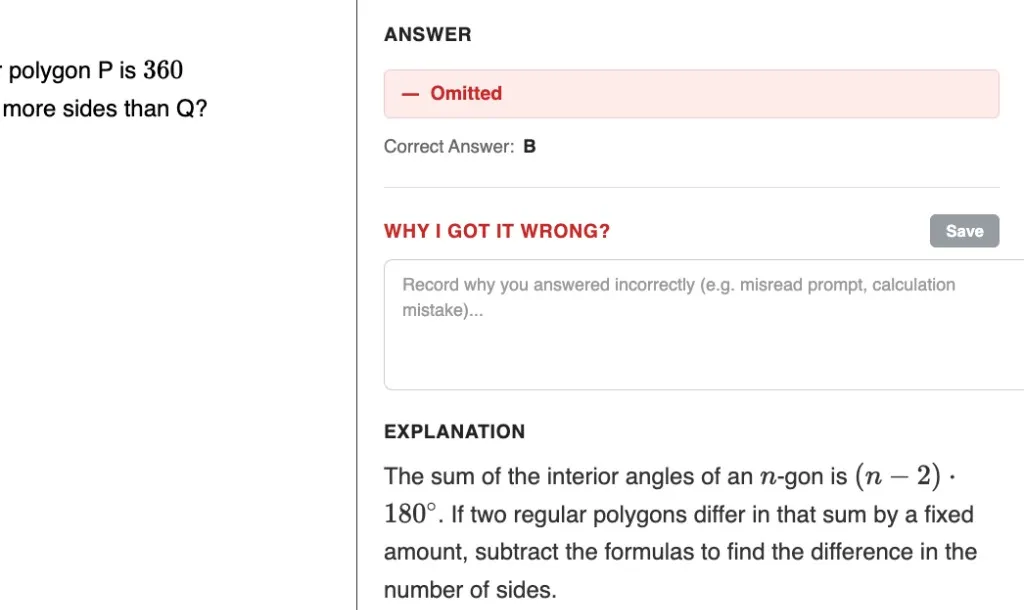
An error log is not a graveyard of wrong answers. It is a repair system. GREKMF’s review workflow makes this concrete by letting you record why you missed a question, group mistakes by weakness, and return to them deliberately.
For every wrong or uncertain answer, record:
- What happened? State the mistake precisely.
- Why did it happen? Was it a concept gap, misreading, trap, careless arithmetic, weak vocabulary, passage misunderstanding, unsuitable strategy, or bad timing decision?
- What is the corrective idea? Write one short rule in your own words.
- Can you solve it again? Re-solve without looking at the explanation.
- Can you transfer the lesson? Do another question testing the same weakness.
- When will you revisit it? Review recurring categories, not only individual questions.
Example:
Mistake: I chose a Quant answer after calculating the average of the values instead of the weighted average. Cause: I recognized the topic but ignored unequal group sizes. Fix: Before averaging, ask whether every group contributes equally. Retest: Re-solve this question, then complete two more weighted-average problems.
For Reading Comprehension, record your reasoning, not merely the answer letter. Ask: Which sentence supports the correct choice? Why is the tempting choice wrong? Did I confuse an example with the main point? Did I choose something plausible that the passage never states?
The objective is simple: do not make the same kind of mistake twice.

A practical study sequence for a beginner
Phase 1: learn fast while starting practice
Use PrepSwift Quant Foundation lessons for concepts and its Verbal strategy lessons for RC, TC, and SE. If you have roughly a month or more, finish the essential material quickly, often during the first one or two weeks, while you are already practicing questions.
Do not spend a month “getting ready to practice.” Make short notes, apply the lesson immediately, and return to a video only when questions expose a gap.
Phase 2: run Quant, RC, and vocabulary together
Do not finish an entire Quant bank before beginning Reading Comprehension.
A balanced main phase includes:
- KMF Quant practice focused first on understanding and traps.
- Short-passage Reading Comprehension practice reported or reconstructed from past GRE exams.
- GREKMF Vocab Mountain every study day.
- Error review after each block.
Start Quant without strict timing if your reasoning is unstable. When accuracy becomes reliable, progressively introduce timing. A useful practical checkpoint is roughly 60–80% accuracy within a section, but do not treat that as a universal cutoff.
For RC, actively rephrase or simplify ideas and track the job of each sentence: background, evidence, example, contrast, challenge, or conclusion. Do not merely read and hope the passage “sticks.”
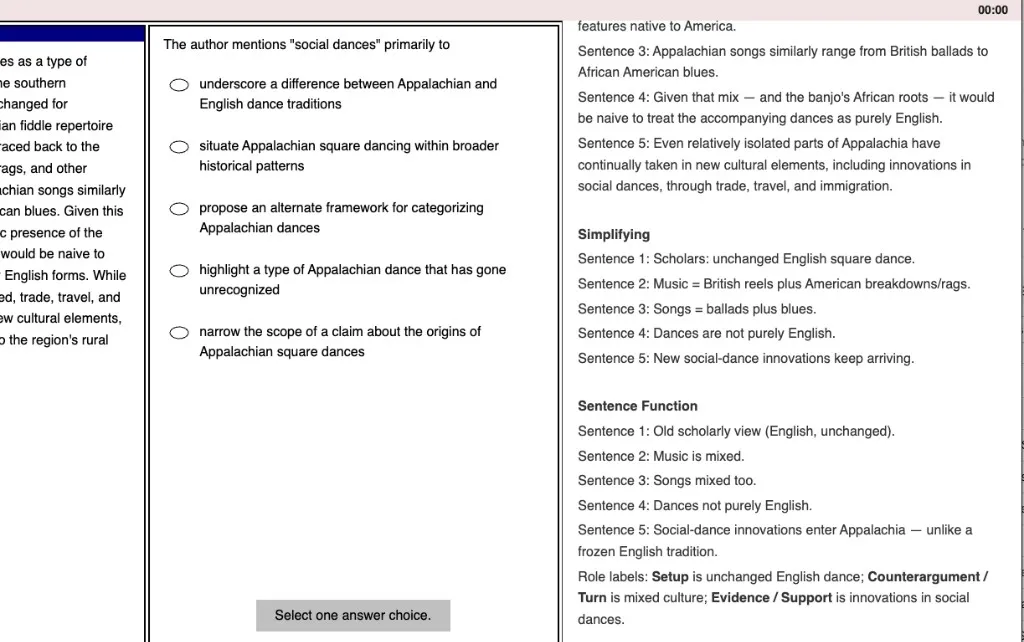
GREKMF’s sentence-function view turns “I think I understood it” into a checkable reading process: identify what each sentence is doing, then test the answer choices against that structure.
Phase 3: add heavier TC and SE
Once you have useful vocabulary and understand the strategies, shift more Verbal time toward Text Completion and Sentence Equivalence. If the exam is close, do not wait to finish a perfect vocabulary cycle. Use the words you already know, repair forgotten groups, and start applying them.
Phase 4: move into timed sets and official readiness checks
As reasoning stabilizes, add selected timed sections and full sets. Preserve unused official POWERPREP tests for late-stage readiness checks and interface familiarity. Take each test in one realistic sitting, without casual pauses, phone use, or consulting answers. Leave enough time to review it.
A score from a previously seen test is less useful as an unseen readiness measure. Use official mocks as evidence, not prophecy.

Official resources first: practice what the GRE actually asks
Let me be direct: do not build your entire preparation around random third-party questions. Classes and books can teach a concept, but the questions that teach you the GRE’s wording, traps, logic, vocabulary, and difficulty are official ETS questions and carefully organized questions reported or reconstructed from past GRE exams.
Official ETS POWERPREP: PP1, PP2, PPP1, and PPP2
| Resource | What it is | Best use |
|---|---|---|
| PP1 and PP2 | Official free POWERPREP practice tests | Late-stage interface practice, pacing, stamina, and readiness checks |
| PPP1 and PPP2 | Paid POWERPREP PLUS practice tests | Additional official full-test practice when you need more unseen official material |
Think of all four as scarce official assets. Do not burn through PP1, PP2, PPP1, and PPP2 casually at the start of preparation. Save them until you can take each test in one realistic sitting, without casual pauses, phone use, or consulting answers. Their best value is seeing how your reasoning, pacing, stamina, and interface familiarity behave in an official environment.
Review every test as seriously as you take it. A previously seen test is less useful as an unseen readiness measure, and an official mock is evidence rather than a guaranteed prediction. Confirm the current ETS names, availability, and purchase terms before planning around a specific POWERPREP PLUS test.
PrepSwift and GregMat
Use PrepSwift to learn Quant concepts and Verbal strategies quickly but properly. Watch the lesson, make a short note, and immediately apply it to questions. Do not spend a month watching classes before you begin serious practice. Use GregMat’s Vocab Mountain method to build vocabulary and keep reviewing every older group as you move forward.
Vocab Mountain: one new group, then Group 1 through Group N
The GREKMF Vocab Mountain contains 960 words in 32 groups, with definitions, examples, synonyms, and a red/green learning status. The method is cumulative: on Day N, learn one new 30-word group, then review every group from Group 1 through Group N. Learning today’s group is only half the task; the older groups are what make the words stay available under test pressure.
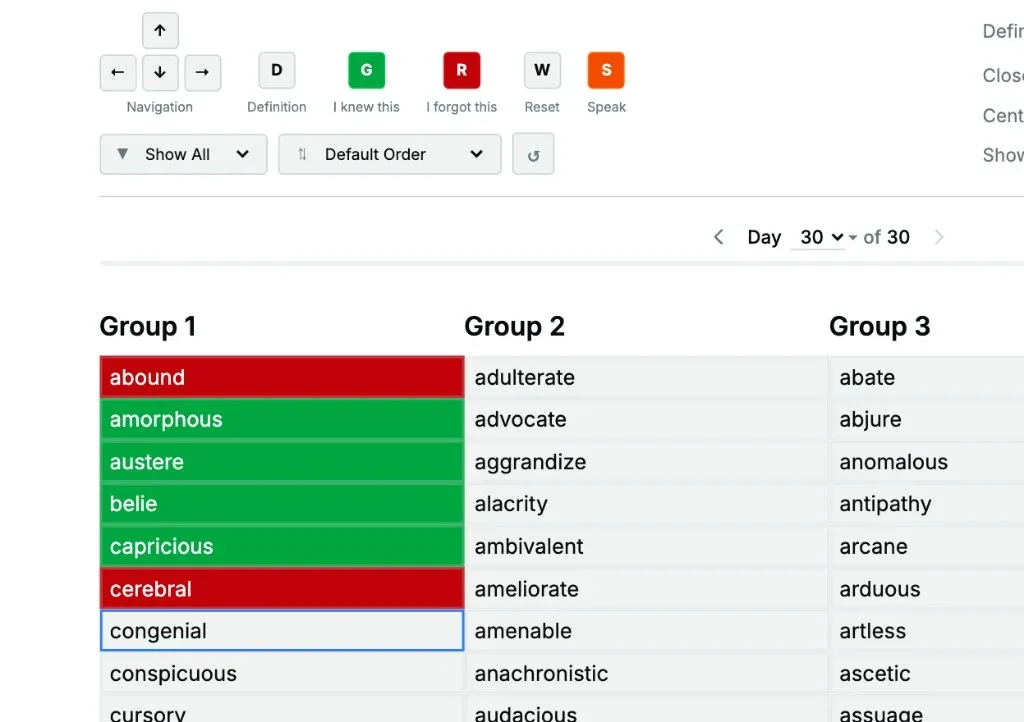
Use this daily routine:
- Learn one new group. Read the definitions, examples, and synonyms until you can recall the core meaning without help.
- Reduce each word to a recall cue. Learn a definition you can say in one or two words—three short words at most. Do not recite a full dictionary sentence. For example, think “candid = frank” or “abate = become less.”
- Review Group 1 through Group N. Look at one word, say its short definition immediately, and decide whether you truly knew it.
- Press G for “I knew this.” Mark it green only when the definition came quickly and accurately.
- Press R for “I forgot this.” Mark it red if you forgot, hesitated too long, or gave the wrong meaning. Do not negotiate with yourself; mark it and move on.
- Repair the red words. Relearn them after the fast pass, then check them again later.
The target review speed is simple: 30 words × about 2 seconds each = 60 seconds for one familiar group. That one-minute pass works because you are not rereading examples or producing full sentences. You are making a fast, binary decision—correct or wrong—then moving to the next word. A newly learned or weak group can take longer; the one-minute pace is the goal for recall review.
KMF 1000, 60Set, and 24Set: past GRE questions organized for practice
KMF is a Chinese preparation platform. KMF 1000, 60Set, and 24Set are collections of questions reported or reconstructed from past GRE exams. They are not ETS-published products, so do not confuse them with PP1, PP2, PPP1, or PPP2. Their value is that they give you far more practice with the wording, traps, reasoning, vocabulary, and difficulty students have actually encountered on the GRE.
Official ETS material is scarce. If you repeat the same small official pool again and again, the score stops telling you much because you already remember the questions. KMF 1000, 60Set, and 24Set solve the volume problem by giving you a much larger bank of past-exam questions to practice and review.
Use the focused GREKMF banks when you are repairing one skill: Quant, Reading Comprehension, Text Completion, and Sentence Equivalence. Use 60Set and 24Set when you need mixed section practice and a more test-like sequence. This is better than randomly clicking questions because the next set is chosen by the weakness your error log has already exposed.
The original KMF interface and Chinese explanations can be difficult for an English-language learner. GREKMF organizes these materials in English with a GRE-like exam interface, detailed explanations, error tracking, topic and unit labels, and performance analysis.


Why standardized tests can be beaten with the right questions
Standardized tests are beatable because the exam keeps testing a limited set of concepts, reasoning patterns, traps, and timing decisions. You do not need to solve every question ever written. You need to practice the closest available questions, understand why you got each one wrong, and make sure the same mistake does not happen twice.
Use the resources in this order:
- Learn the necessary concepts and strategies quickly but properly.
- Use PP1, PP2, PPP1, and PPP2 as scarce official ETS mocks and interface practice.
- Use KMF 1000, 60Set, and 24Set for a much larger volume of questions reported or reconstructed from past GRE exams.
- After every wrong or uncertain answer, ask: Why did I make this mistake?
- Record the cause, learn the corrective idea, re-solve the question, and practice the same weak skill again.
This is the real point of using past GRE questions. You are not just collecting answers. You are learning how the GRE asks, where it sets traps, which vocabulary keeps appearing, how it disguises familiar concepts, and how your own mistakes repeat. KMF solves the shortage of practice questions. GREKMF makes those questions easier to practice, understand, track, and review in English.
The GREKMF catalog includes 8,172 questions across Quant and Verbal collections, including KMF 1000 Quant, Quantitative Comparison, Text Completion, Sentence Equivalence, Reading Comprehension, 60Set, and 24Set material. Questions carry more than 200 domain and unit labels, allowing targeted weak-skill practice.
GREKMF also provides:
- Original step-by-step explanations.
- Error logging and review.
- Domain and unit accuracy.
- Score and timing trends.
- Answer-change patterns.
- Recurring weak-skill analysis.
- GRE-style typeset math.
- Redrawn HD diagrams for KMF 1000 Quant and 24Set; 60Set redraws are ongoing.
- A free, non-expiring workspace with KMF 1000 Quant and explanations after signup.
- A free Vocab Mountain without signup.
- A free diagnostic based on the first 24Set.
- A GRE-style interface designed to make practice feel closer to PP1/PP2 and the real exam.
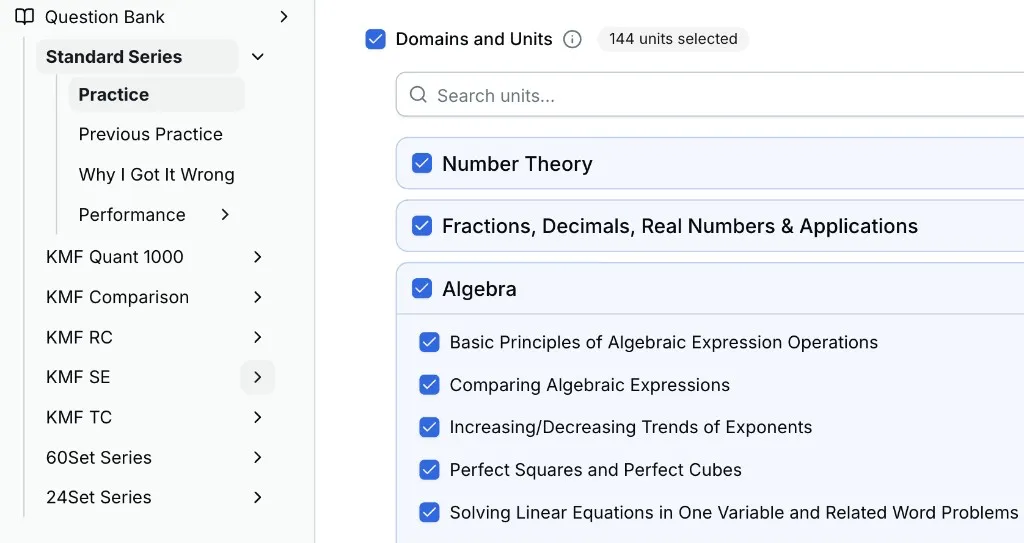
Topic filters let you turn a broad score problem into a specific practice plan: choose the weak domain or unit, practice it, and then check whether the error rate falls.
What to expect at a test center

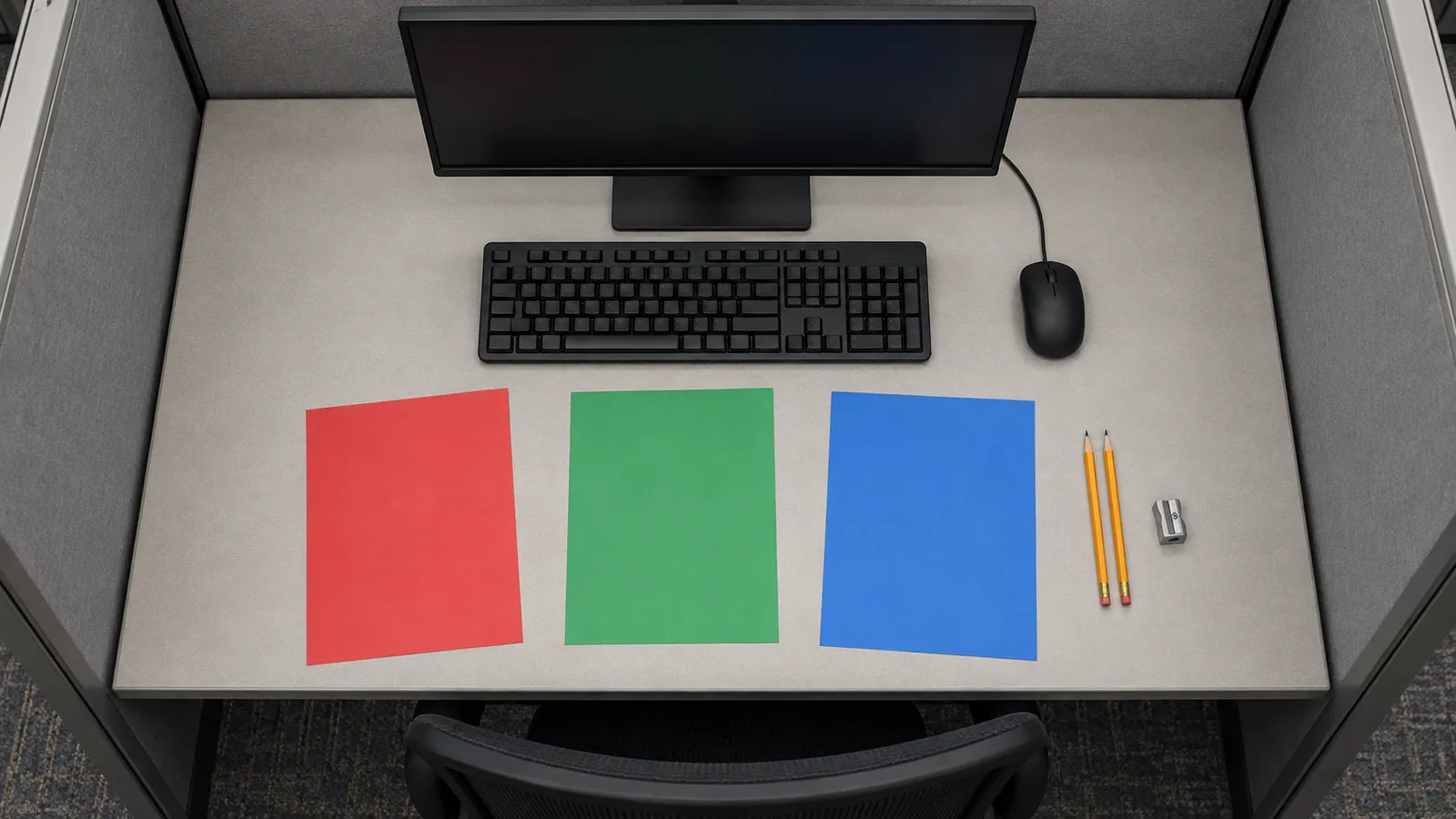
Be prepared for a cold room, a desktop-style keyboard and mouse, colored scratch sheets, and pencil-based working. Exact conditions vary by center, so follow your appointment email and the staff’s instructions.
The room may be cold
Testing rooms can have strong air conditioning. Bring an appropriate extra layer if the center’s rules allow it to be worn inside. During practice, occasionally work in a cool room so temperature does not become a surprise.
Expect a desktop setup
Practice with a full-size external keyboard and mouse, not only a laptop keyboard and trackpad. Familiarity with physical key placement, mouse movement, and the on-screen calculator can reduce unnecessary friction.
Scratch work may use colored paper
Scratch work may be done on colored A4 sheets with pencils. Do not expect unlimited sheets on your desk. When you need replacements, you may need to hand over the used sheets before receiving fresh ones.
Practice this at home:
- Start with three colored A4 sheets as a rehearsal setup.
- Keep calculations organized and local to one area.
- Do not spread one problem across several sheets unless necessary.
- When the sheets are full, put the used stack out of reach before taking fresh sheets.
- Use a new area instead of erasing every calculation, unless erasing genuinely helps.
- Practice with pencils, an eraser, and a sharpener, but do not assume your center will issue or allow every item. Follow the center’s instructions.
Rehearse the complete environment
A good home mock includes the questions, exact timing, one-sitting discipline, desktop keyboard and mouse, scratch-paper exchange habit, calculator familiarity, room temperature, and serious review afterward. Paying for an offline mock is usually unnecessary if you can reproduce these conditions honestly at home.
The on-screen calculator
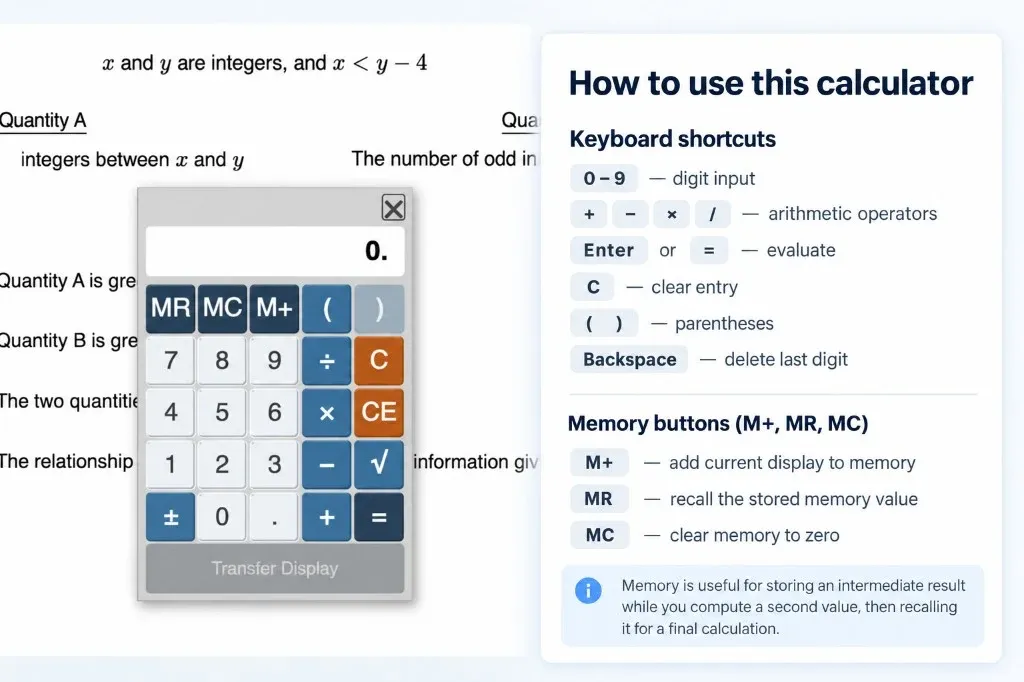
In PP1, PP2, and the GREKMF exam interface, the calculator normally shows the current number or result rather than the full expression while supporting operator precedence, parentheses, plus/minus, square root, and memory controls.
The display style and the calculation behavior are separate. A calculator does not need to display the entire expression for brackets and order of operations to work.
Practice both the free GRE calculator and the calculator inside timed Quant questions. Learn the keyboard controls as well as the buttons: digits and operators for entry, Enter or = to evaluate, C to clear, Backspace to remove the last digit, and M+, MR, and MC for memory. The in-exam version teaches you how to open, move, use, and close it while managing the rest of the interface.
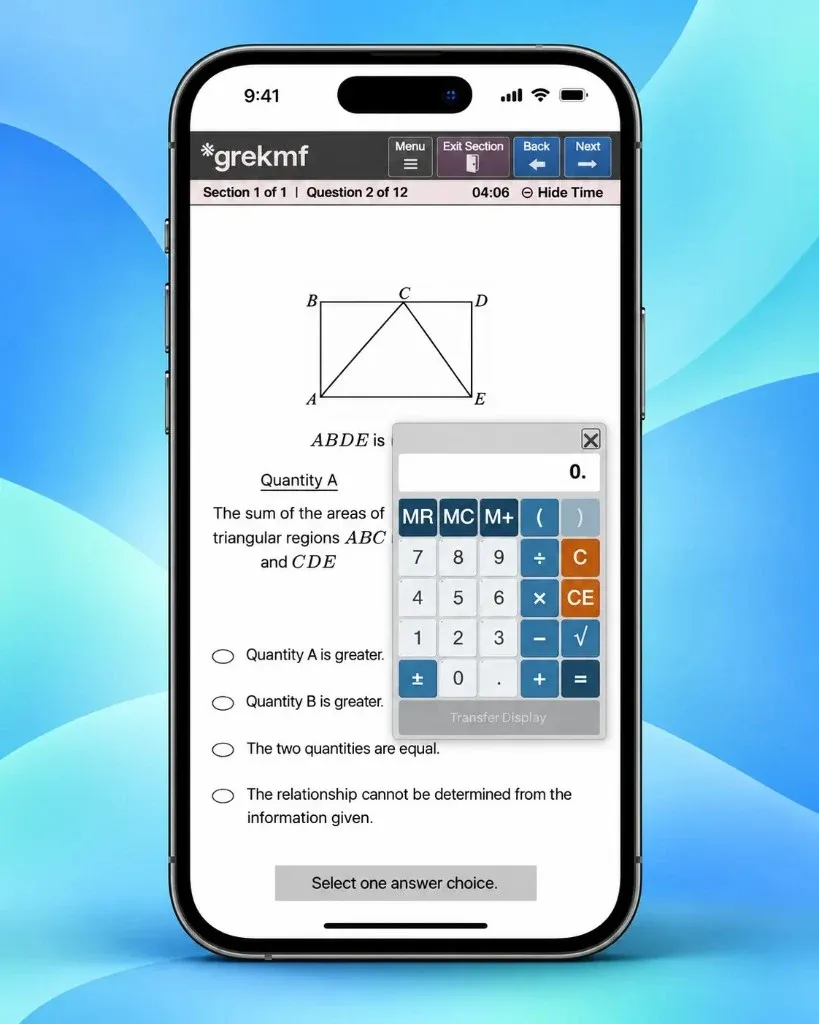
In GREKMF, you can also use the calculator on mobile for practice when you are away from your desk.

What happens after the test?
At the end of the test, you can see your unofficial Quant and Verbal results on screen. These are useful for an immediate indication and reportedly change only rarely, but they are not the final official score report.
Before test day, write down and memorize the institution or recipient codes you may need. Do not rely on remembering them while exhausted after the exam. Also keep the codes in a secure place outside the testing room for later reference.
Your official result arrives after ETS processing. Because the exact delay and reporting workflow can change, confirm the current estimate in your ETS account and appointment materials; plan applications with buffer rather than assuming same-day official delivery.
GRE scores are generally reportable for a multi-year window, but the exact validity rule and its date calculation are official-policy details. Confirm the current ETS rule for your test date before building a long admissions timeline.

A realistic final-week plan
The final week is not the time to begin an eight-week curriculum. Use the GRE test countdown to see the remaining days clearly, and use the GRE essay timer for short, realistic Analytical Writing rehearsals.
Prioritize:
- Your error log and recurring weak skills.
- Forgotten vocabulary.
- Targeted Quant repair.
- Selected timed work.
- Heavy Text Completion and Sentence Equivalence practice if RC is already established.
- An unused official readiness check—or the free GRE diagnostic when you need a fresh baseline—when appropriate.
- Review and rest.
Do not schedule a new full test every day. A mock you do not review is mostly a stamina exercise.
If a late official practice result is meaningfully below your goal, compare the gap, the remaining time, and the importance of the score to your applications. Postponement can be reasonable, but do not use a single generic rule. Check the actual rescheduling terms before deciding.
How to prepare for AWA: write, score, revise, repeat
The current GRE Analytical Writing measure is one 30-minute Analyze an Issue task. It tests whether you can take a clear position, examine the issue’s complexity, support your reasoning, organize the discussion, and communicate in standard written English. It does not test specialized subject knowledge, and the raters are not looking for one “correct” opinion.
Use the official ETS GRE Issue Topic Tool or download the official Issue Topic Pool PDF. The prompt on your test will come from this pool, although wording may vary slightly. Always respond to the specific directions attached to the issue—not merely the broad topic.
Your first AWA practice
Begin with this official Practice Test 1 issue:
The best ideas arise from a passionate interest in commonplace things.
Write your response before reading the sample essays. Discuss how far you agree or disagree, consider circumstances in which the statement may or may not hold, and explain how those qualifications shape your position.
Use the 30 minutes deliberately
- About 4 minutes—plan. Parse the exact instructions, choose a qualified position, list two developed reasons or examples, and identify one complication or counterpoint.
- About 23 minutes—write. Make every paragraph advance one part of the argument. Explain why each example proves the point instead of merely naming it.
- About 3 minutes—revise. Check whether you followed the directions, remove unclear sentences, repair obvious grammar and spelling problems, and strengthen transitions. The GRE editor has no spellchecker or grammar checker, so practice without them.
The free GREKMF essay timer can help you rehearse the exact 30-minute constraint.
Score the essay the way ETS scores it
Read the official Practice Test 1 sample responses and reader commentaries. Give yourself a provisional score from 1 to 6, then justify that score with evidence from your own writing across five questions:
- Task fulfillment: Did I answer the exact instructions and state a clear, thoughtful position?
- Development: Did I fully explain my reasons and examples, or did I rely on unsupported claims?
- Organization: Is the analysis focused, logically ordered, and connected with useful transitions?
- Language: Are the sentences clear, reasonably varied, fluent, and precise rather than inflated?
- Standard English: Do grammar, usage, spelling, and mechanics support meaning instead of interfering with it?
A 6 requires an insightful position, compelling development, sustained organization, precise language, and strong control of written English. A 5 is thoughtful and well developed but may be less insightful, less fully developed, or less precise. A 4 is competent and clear with relevant support, while a 3 is noticeably limited by vague development, weak examples, organization, language, or recurring errors.
Use the commentary as a revision checklist
- Read the score-6 response and commentary, then the 5, 4, 3, 2, and 1 responses. Notice what changes from one score level to the next.
- Write down the two strongest features of your essay and the two clearest reasons it did not earn the next score.
- Rewrite the same essay. Deepen an underdeveloped example, qualify an overbroad claim, improve the logical connection between paragraphs, and replace vague or wordy language.
- Score the revision with the same five questions. Do not raise the score unless you can point to concrete improvements in the text.
- Choose a new prompt from the official pool and repeat the process under 30-minute conditions.
Keep a small AWA error log. Track recurring problems such as ignoring part of the instructions, using an example without explaining it, repeating the thesis instead of advancing the analysis, writing absolute claims that need qualification, weak transitions, wordiness, sentence fragments, and avoidable grammar errors. Your goal is not to memorize essays. It is to make the scoring criteria automatic.
The annotated beginner’s checklist
Before preparation
During preparation
Before test day
Final advice
The GRE rewards disciplined familiarity. You do not need ten courses, six books, and an endless collection of strategy videos. You need a compact learning phase, a large amount of appropriate practice, and a ruthless review habit.
Use PP1, PP2, PPP1, and PPP2 carefully because official ETS material is scarce. Then use KMF 1000, 60Set, and 24Set to practice a much larger volume of questions reported or reconstructed from past GRE exams. GREKMF puts those materials into a cleaner English-language workflow with explanations, topic labels, analytics, error review, and an exam interface designed to feel closer to PP1, PP2, and the real GRE.
Most importantly, treat every mistake as data. Record why it happened. Fix the cause. Test the fix on another question. Then revisit it later.
That is how you beat a standardized test: practice the right questions, review properly, and do not make the same mistake twice.