GRE at Home vs Test Center: A Practical Guide
Strategy
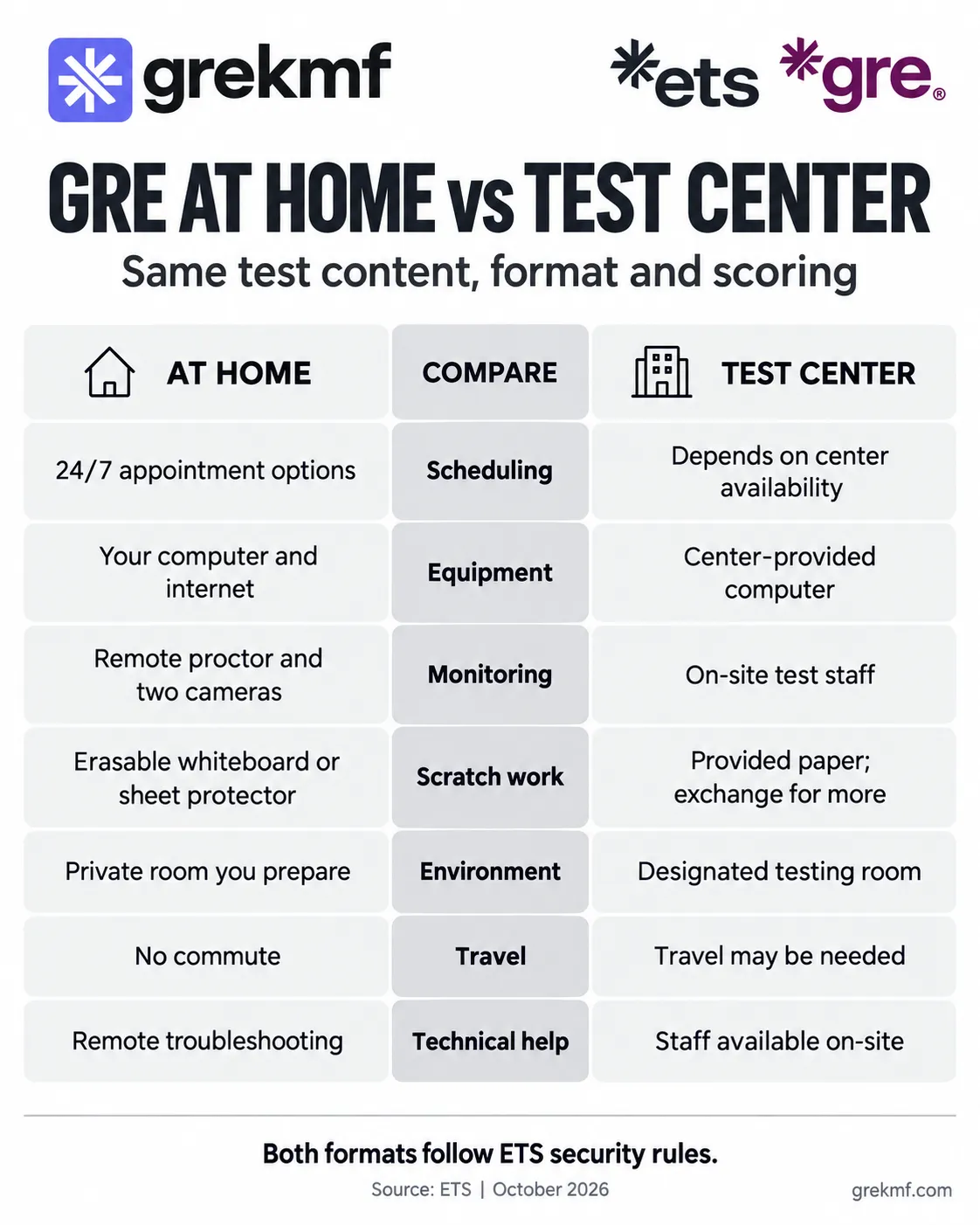
Why I recommend a test center, and what to check before choosing the convenience of home
Overview
This post is about the setting, not the questions. The standard GRE General Test lasts about 1 hour and 58 minutes either way. Here is what I will cover:
- Why I default to a test center
- What can go wrong with home equipment and internet
- How remote monitoring actually works
- Scratch work: whiteboard versus paper
- Score-cancellation fears, without the rumor mill
- Test-center tradeoffs, including travel
- When home testing is the better call
- A booking checklist you can use before you pay
If you are still in the practice phase, do that work in a real exam layout on GREKMF so test day is not the first time you sit a timed section. The free KMF 1000 Quant is a good place to start.
1. Why I default to a test center
You have spent months preparing. Picture arriving on test day and spending the next hour trying to get the exam to open.
That possibility belongs in the booking decision. A familiar room is appealing. So is walking into a center where the computer and the testing space are already provided.
If I can find a suitable appointment and manage the travel, I take the GRE at a test center. It takes several jobs off my plate when I need my attention on the questions.
The GRE at-home testing page describes the home version as identical in content, format, and scoring. Your choice is the conditions around that test.
2. Technical problems can interrupt more than your connection
At home, your computer and internet become part of the exam. If something fails, you may be troubleshooting with a remote proctor while the clock and the pressure are already on.
In an r/GRE thread about this choice, one commenter described a failed launch after an earlier diagnostic check, then a second attempt interrupted by camera-framing requests and more technical problems. Those are individual accounts. They show what can go wrong. They do not tell you how often it happens.
Keep the official rules in view:
- A brief drop is not an automatic cancellation. The at-home test-day instructions say you can reconnect when the connection returns, and the proctor may reopen the exam if possible.
- Failing the home equipment or environment check on test day is different. The same at-home requirements say that means no test, no refund, and no free reschedule.
My concern is the interruption itself. Even a problem that gets resolved can leave you trying to recover concentration before a hard Verbal passage or a multi-step Quant item.
If you want that concentration trained before you book, sit timed sections in the GREKMF exam session and use the on-screen GRE calculator the way you will on test day. We also keep a walkthrough of that calculator.
3. A familiar room still comes with strict monitoring
Home testing is not unsupervised. The session is recorded, your screen is monitored, and you must stay visible.
Review these before you choose home:
- Talking to yourself, looking away from the screen, or moving out of camera view can be treated as grounds to invalidate a test. That is in the at-home test-day rules.
- You do not need a special panoramic webcam. You do need a camera that can move to show the room, plus a smartphone or tablet as a second camera. That setup is listed on the at-home testing page.
- If a proctor asking you to adjust your chair or camera would rattle you mid-section, that is a reason to prefer a center.
If your practice habit is reading questions aloud or staring at the wall while you think, rehearse without those habits. A timed set on GREKMF is closer to the real constraint than casual homework at the kitchen table.
4. Your scratch work deserves more attention than you think
If you have been solving Quant on ordinary paper, changing the writing surface on test day is an extra adjustment you do not need.
At home, you may use:
- a small erasable whiteboard, or
- a sheet of paper inside a transparent protector, with an erasable marker
At home, you may not use:
- ordinary paper notes
- pens or pencils
That restriction is in the at-home testing requirements.
At a test center:
- staff provide scratch paper
- you hand it in when it is full and get more
Those details are in the GRE Information Bulletin.
An erasable surface will not slow everyone down. It will change how you work if you usually spread calculations across a page or jump back to an earlier line.
Do this before you book home testing: run one full timed Quant section with only the permitted materials. Track three things:
- How often you erase
- Whether the work stays readable
- How easily you check a previous step
Use a real Quant bank for that sitting, not a handful of scattered problems. The KMF 1000 Quant on GREKMF is free, and this post explains how the sets are organized.
5. The fear of losing a score you earned
The fear is straightforward: you prepare honestly, you take the test, and then you worry the score will not be released.
Scores can be canceled for misconduct and for testing irregularities, including equipment or administrative problems. A cancellation is not proof of cheating. A test center also does not make a score immune to review. Both points are in the GRE Information Bulletin.
I still prefer a center for a practical reason: it removes my computer, my home network, and my room setup from the list of things I have to get right.
If something goes wrong:
- Write down what happened as soon as you can
- Contact official support, not a forum workaround
- Do not plan around an assumed refund or a guaranteed retake
6. A test center has tradeoffs too
A center is not free of friction. Treat these as real costs, not afterthoughts:
- Travel costs money
- A long trip can leave you tired before the first section
- The date and time you want may not exist at the nearest site
If distance is the main obstacle and your budget allows it, arrive the day before. A nearby hotel or a relative’s home can turn an exhausting commute into a short morning walk.
On the day:
- Confirm the route the night before
- Build in buffer for check-in
- Plan to arrive at least 30 minutes early, as the test-center test-day page asks
Centers can fail too. For some delayed or rescheduled appointments caused by circumstances beyond the administrator’s control, the same page describes a free new appointment or a refund. That is not a promise that staff will add time after every glitch.
The advantage I care about: someone is physically there when I need help.
Once you have a date, put it on a GRE countdown so the remaining weeks stay visible while you practice.
7. When taking the GRE at home makes sense
Home testing is not a trap. It is a real option with real benefits:
- No commute
- A room you already know
- Appointment windows around the clock, seven days a week, per the at-home testing page
I would consider it when at least one of these is true:
- Travel would leave you exhausted
- A suitable center appointment is not available before your deadline
- You genuinely concentrate better at home than in a cubicle
I would not book it until I had done all of this:
- Read the equipment and room requirements
- Practiced with the permitted scratch materials
- Decided that a remote proctor and a second camera would not distract me
- Confirmed that home internet and power are reliable
Unreliable internet or power is enough, on its own, to choose a center.
8. Make the decision before your deadline makes it for you
Pay after you have compared real options, not after you have assumed home is “easier.”
- Check actual center dates and travel costs. Look up a real appointment. Price the trip. Compare that with home.
- Rehearse the home setup if you are still considering it. Run the official equipment check, finish identity verification, and practice under the at-home rules.
- Leave slack before your application deadline. You need time for score reporting, a technical mess, and a possible retake. A GRE diagnostic is a cheap way to see whether you are booking too early.
If both options are practical, I would book the test center. The trip is worth having fewer things to manage during the exam.
Summary
- Content, format, and scoring are the same. The difference is who provides the computer, the room, and the scratch paper.
- A test center takes equipment, monitoring logistics, and most technical troubleshooting off your plate.
- Home testing is worth it when travel is the worse problem, and you have already rehearsed the rules, the cameras, and the whiteboard.
- Do not discover your scratch-work method, your internet, or your camera setup on test morning.
Choose the setting that lets you give the GRE your full attention. Make that choice while you still have options.
If you are still practicing: question bank on GREKMF, tools and resources, and the rest of the GREKMF blog.