GRE Sentence Equivalence Practice
Sentence Equivalence is not simply a synonym hunt. The two selected words must both fit the sentence and produce completed sentences with equivalent meanings.
How Sentence Equivalence works
Each item offers six choices and requires exactly two. Start with the sentence's logic, predict the missing idea, then find the pair that independently satisfies it.
- Choose exactly two answers
- Both must fit the same blank
- The completed sentences must mean the same thing
The pairing method
Group likely synonyms, but do not select a pair until the sentence confirms it. If two words are synonyms yet both clash with the clue, they are a deliberate trap.
- Mark contrast and cause signals
- Predict tone and direction
- Test each word separately
Common SE traps
The test often includes a perfect synonym pair with the wrong meaning, a single excellent fit with no equivalent partner, or near-synonyms that create materially different sentences.
From the GREKMF question bank
Real questions with Premium explanations
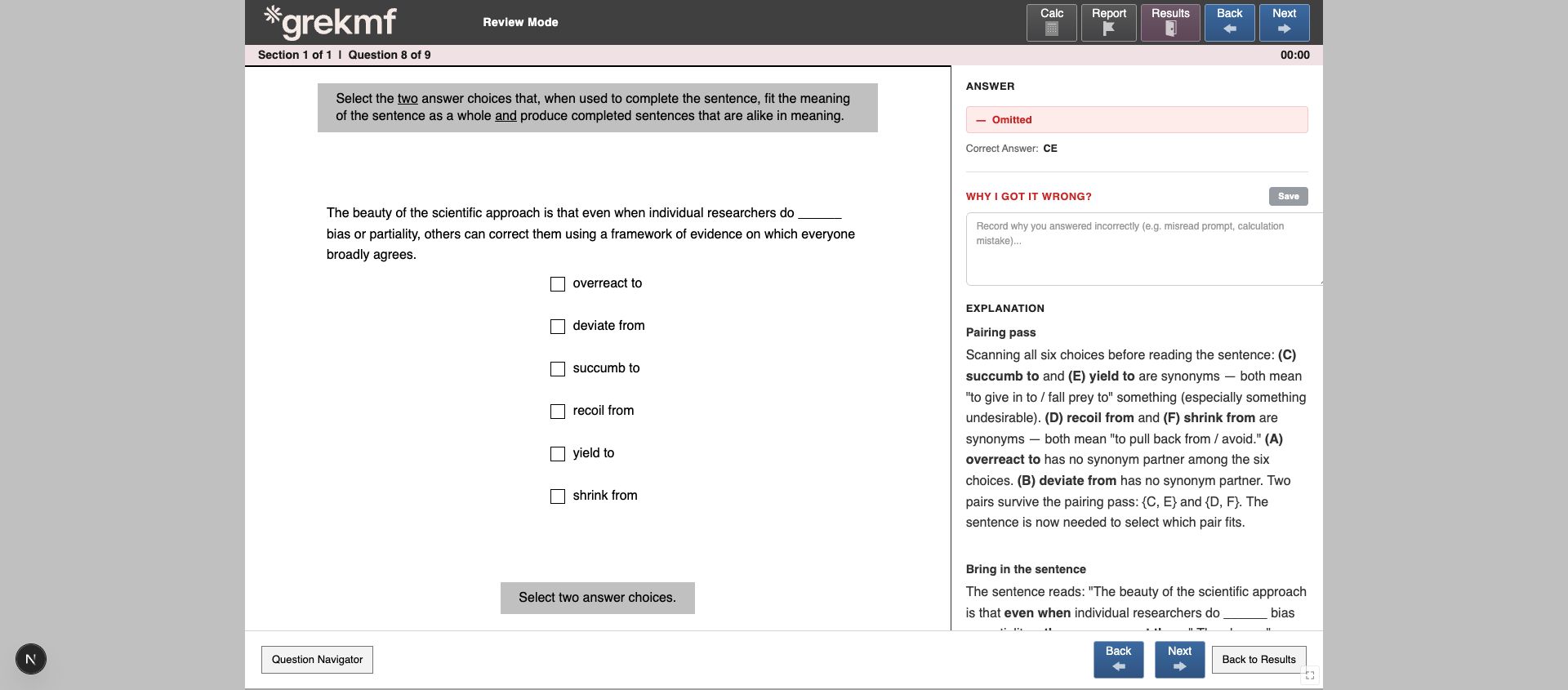
Question 1 · GREKMF #8001
medium · se
Show correct answer and full Premium explanation
Correct answer: CE
Pairing pass
Scanning all six choices before reading the sentence: (C) succumb to and (E) yield to are synonyms — both mean "to give in to / fall prey to" something (especially something undesirable). (D) recoil from and (F) shrink from are synonyms — both mean "to pull back from / avoid." (A) overreact to has no synonym partner among the six choices. (B) deviate from has no synonym partner. Two pairs survive the pairing pass: {C, E} and {D, F}. The sentence is now needed to select which pair fits.
Bring in the sentence
The sentence reads: "The beauty of the scientific approach is that even when individual researchers do ______ bias or partiality, others can correct them." The phrase "even when... others can correct them" is a concessive structure: it acknowledges that researchers sometimes exhibit bias — and that the system has a correction mechanism for it. The blank must describe something the researchers are doing to bias — something that requires external correction. Giving in to bias (pair {C, E}) creates a problem to be corrected. Avoiding bias (pair {D, F}) creates no problem at all — there would be nothing to correct. Pair {C, E} is the only pair consistent with the sentence's logic.
Answer choice analysis
(Choice A) overreact to — no synonym partner among the six choices; eliminated on the pairing pass alone.
(Choice B) deviate from — no synonym partner among the six choices; eliminated on the pairing pass alone.
(Choice C) succumb to — Correct. Means "to give in to" bias — researchers who succumb to bias create an error that others can correct, which is exactly what the sentence describes.
(Choice D) recoil from — paired with "shrink from," but both mean to avoid bias. If researchers avoid bias, they haven't done anything wrong and there is nothing for others to correct. Contradicts the sentence's logic.
(Choice E) yield to — Correct. A direct synonym of "succumb to" in this context, meaning "to give way to" bias. Forms the correct pair with Choice C.
(Choice F) shrink from — paired with "recoil from," same problem: both mean avoidance of bias, leaving nothing to correct. Contradicts the sentence's logic.
Things to Remember:
- Always complete the pairing pass before reading the sentence — any word without a synonym partner cannot be part of the correct answer and is eliminated immediately.
- When two pairs survive the pairing pass, read the full sentence structure to determine which pair is logically consistent — here, the concessive clause "even when... others can correct them" signals that the researchers are doing something problematic, selecting the "give in to" pair over the "avoid" pair.
- Two words can be near-synonyms in isolation but point in completely opposite directions when inserted into the sentence ("succumb to bias" vs. "recoil from bias") — always verify the direction of the phrase, not just the word in isolation.
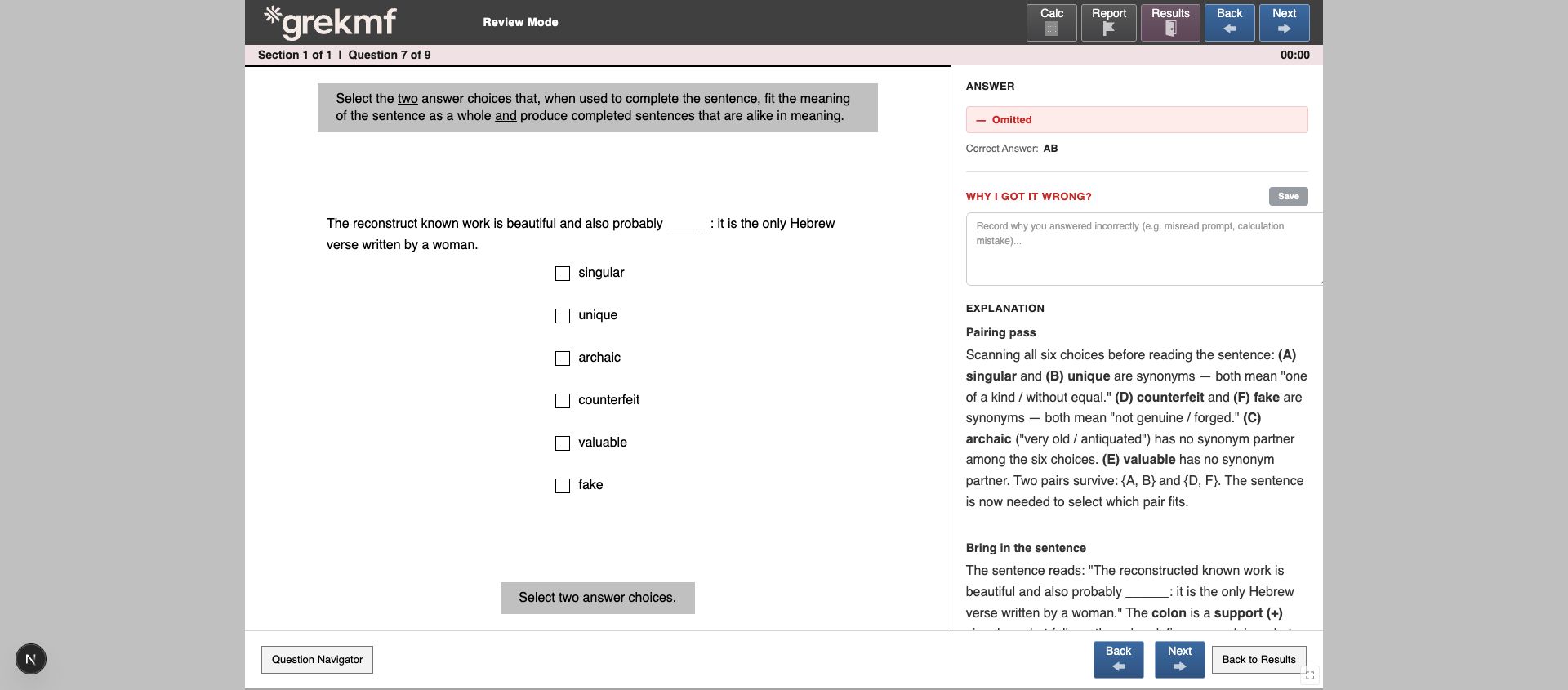
Question 2 · GREKMF #8002
medium · se
Show correct answer and full Premium explanation
Correct answer: AB
Pairing pass
Scanning all six choices before reading the sentence: (A) singular and (B) unique are synonyms — both mean "one of a kind / without equal." (D) counterfeit and (F) fake are synonyms — both mean "not genuine / forged." (C) archaic ("very old / antiquated") has no synonym partner among the six choices. (E) valuable has no synonym partner. Two pairs survive: {A, B} and {D, F}. The sentence is now needed to select which pair fits.
Bring in the sentence
The sentence reads: "The reconstructed known work is beautiful and also probably ______: it is the only Hebrew verse written by a woman." The colon is a support (+) signal — what follows the colon defines or explains what the blank means. After the colon: "it is the only Hebrew verse written by a woman." The word "only" directly signals singularity — there is nothing else like it. The blank must therefore mean "one of a kind," selecting pair {A, B}. Pair {D, F} (counterfeit / fake) would mean the work is probably not genuine — but the sentence provides no evidence of inauthenticity; it says the work is "beautiful," not suspected to be forged.
Answer choice analysis
(Choice A) singular — Correct. Means "one of a kind / remarkable in its distinctiveness" — directly supported by "the only Hebrew verse written by a woman."
(Choice B) unique — Correct. Direct synonym of "singular" in this context; the only example of its kind, confirmed by the explanatory clause after the colon.
(Choice C) archaic — no synonym partner among the six choices; eliminated on the pairing pass alone. Additionally, "archaic" (very old) is not what the colon clause defines: the clause defines rarity, not age.
(Choice D) counterfeit — paired with "fake," but this pair is contradicted by the sentence: the work is described as "beautiful" and the colon clause describes its rarity, not any suspicion of forgery.
(Choice E) valuable — no synonym partner among the six choices; eliminated on the pairing pass alone.
(Choice F) fake — same problem as "counterfeit": the pair {D, F} is contradicted by the sentence's logic. The colon clause explains why the work is special, not why it is doubted.
Things to Remember:
- Always complete the pairing pass before reading the sentence — any word without a synonym partner is eliminated immediately regardless of how well it might "sound" in the sentence.
- A colon is a support (+) signal: the clause after the colon defines or explains the blank, making it one of the clearest possible evidence sources in a TC/SE sentence.
- When a surviving pair is contradicted by the sentence's context (not just a poor fit but actively inconsistent with the tone and facts), eliminate it even if both words in the pair are formally "synonyms."
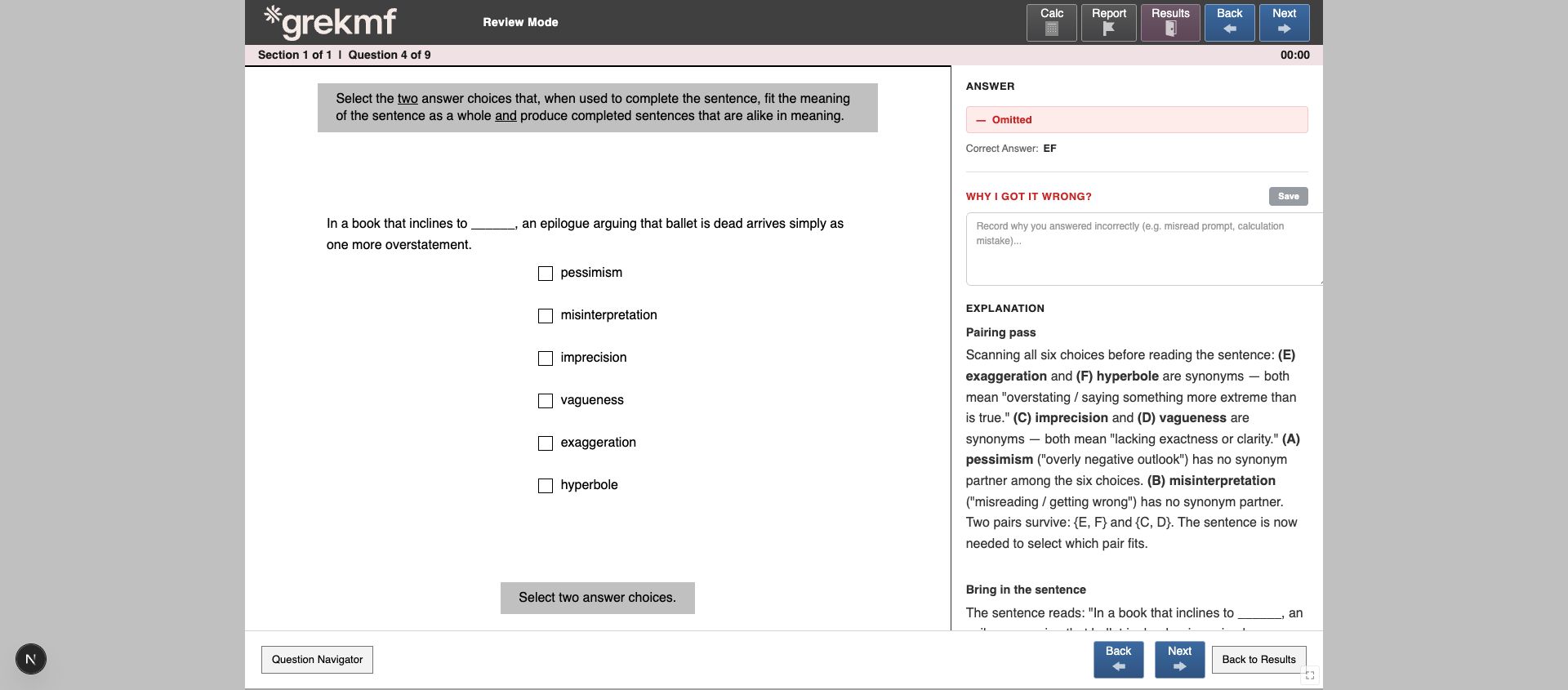
Question 3 · GREKMF #8003
medium · se
Show correct answer and full Premium explanation
Correct answer: EF
Pairing pass
Scanning all six choices before reading the sentence: (E) exaggeration and (F) hyperbole are synonyms — both mean "overstating / saying something more extreme than is true." (C) imprecision and (D) vagueness are synonyms — both mean "lacking exactness or clarity." (A) pessimism ("overly negative outlook") has no synonym partner among the six choices. (B) misinterpretation ("misreading / getting wrong") has no synonym partner. Two pairs survive: {E, F} and {C, D}. The sentence is now needed to select which pair fits.
Bring in the sentence
The sentence reads: "In a book that inclines to ______, an epilogue arguing that ballet is dead arrives simply as one more overstatement." The phrase "one more overstatement" is the key: the epilogue is yet another overstatement, implying the book already contains overstatements — the blank describes the overall tendency that produces them. The blank must mean "overstating." Pair {E, F} (exaggeration / hyperbole) means exactly that. Pair {C, D} (imprecision / vagueness) describes inexactness or lack of clarity — a different kind of flaw that would not naturally produce "overstatements." A vague book produces unclear claims, not exaggerated ones.
Answer choice analysis
(Choice A) pessimism — no synonym partner among the six choices; eliminated on the pairing pass alone. Also, pessimism (a negative worldview) is not the same as overstatement — a pessimistic book can be restrained and accurate.
(Choice B) misinterpretation — no synonym partner among the six choices; eliminated on the pairing pass alone. Misinterpreting something is different from exaggerating it.
(Choice C) imprecision — paired with "vagueness," but pair {C, D} does not match the sentence: imprecision means inexactness, not overstatement. The sentence calls the epilogue "one more overstatement," not "one more inexact claim."
(Choice D) vagueness — same problem as "imprecision": vagueness describes lack of specificity, not a tendency to inflate or exaggerate claims.
(Choice E) exaggeration — Correct. Directly synonymous with "overstatement" — a book that inclines to exaggeration will naturally produce overstatements, including the epilogue's claim that ballet is dead.
(Choice F) hyperbole — Correct. Direct synonym of "exaggeration" in this context; hyperbole is the rhetorical term for deliberate overstatement, making it a perfect fit for a book whose epilogue is described as "one more overstatement."
Things to Remember:
- Always complete the pairing pass before reading the sentence — eliminating partnerless words before analyzing the sentence saves time and prevents distraction.
- Look for the key descriptive phrase in the sentence that defines the blank: here "one more overstatement" does the work of both the signal and the definition, directly pointing to the exaggeration/hyperbole pair.
- Pairs that are "in the same neighborhood" (imprecision and exaggeration are both flaws) can still be wrong if the sentence specifies a particular type of flaw — always match the pair to what the sentence actually describes, not just its general category.
Put the method into practice
Practice in GREKMF’s exam-like question bank
Move from the guide to a focused set, then review detailed explanations and skill-level performance. The KMF 1000 Quant series is free and requires no card.
Start free GRE practiceFrequently asked questions
No. They need to make the completed sentences equivalent in context, even if their dictionary meanings are not identical.
No. Sentence Equivalence always requires exactly two selections.
Build vocabulary in synonym families and practice making a prediction before scanning the six choices.