GRE Practice Questions by Topic
Topic practice is corrective medicine, not the whole diet. Use it to make one process visible, review until the mistake pattern changes, then remove the label and prove the skill in mixed GRE conditions.
Choose a route
Start with the option that matches your goal
Arithmetic and number properties
Integers, factors, remainders, fractions, ratios, percentages, exponents, and roots.
Open this route QuantAlgebra and coordinate geometry
Expressions, equations, inequalities, functions, systems, sequences, and coordinate relationships.
Open this route QuantGeometry
Lines, angles, triangles, polygons, circles, three-dimensional figures, and diagram constraints.
Open this route QuantData analysis
Statistics, tables, graphs, probability, counting, distributions, and percent change.
Open this route VerbalText Completion and Sentence Equivalence
Sentence logic, contrast, continuation, tone, multi-blank relationships, and synonym pairing.
Open this route VerbalReading Comprehension
Main idea, function, inference, detail, attitude, argument structure, and passage evidence.
Open this routeStart with the smallest repeatable weakness
A broad label such as ‘bad at Quant’ cannot produce a useful session. Use performance data to find a unit, format, or reasoning task: remainder problems, QC edge cases, percent-change bases, TC contrast clues, or RC function questions.
Use a three-set progression
Set one is untimed and method-focused. Set two is unseen but still topic-labeled. Set three removes the label by mixing the skill with neighboring topics. If the method disappears in set three, return to review rather than adding more random volume.
- Learn the method
- Drill the exact skill
- Mix neighboring skills
- Verify under time
Review correct answers that were slow or guessed
Accuracy alone can hide fragile reasoning. Mark correct guesses, answers changed without evidence, and problems that exceeded your time threshold. These often predict the next timed miss more accurately than an obvious content error.
Move from topic practice to full GRE transfer
Once isolated accuracy and method recognition are stable, use KMF Quant pairs, standalone Verbal banks, 24Set or 60Set mixed tests, and finally preserved official POWERPREP exams. Every stage should answer whether the skill survives less guidance and more realistic pressure.
Build topic sets from evidence
Start with the performance dashboard, error log, and slow-correct list. Select one domain and one or two units, choose a difficulty that exposes the method without producing pure guessing, and decide the review rule before starting. A set without a diagnostic reason is merely more volume.
For Quant, pair content tags with format when necessary: geometry in QC can fail differently from geometry in numeric entry. For Verbal, pair the bank with the reasoning task: RC inference, passage function, TC contrast, or SE pairing is more actionable than ‘practice Verbal.’
Decide the size and timing of a focused set
Use small sets of roughly five to ten questions when learning or repairing a narrow process. Use longer blocks after accuracy stabilizes so fatigue and pacing become part of the evidence. Avoid strict timing on the first encounter with a new method; add it on the next unseen set.
End with a written transfer goal such as ‘identify the percent-change base without a label’ or ‘reject RC answers that exceed the passage’s scope.’ The next mixed set tests that behavior, not whether you remember yesterday’s answers.
A useful session ends with a decision: repeat the same unit, widen to neighboring units, move to a mixed block, or return briefly to concept repair. Let accuracy, time, and error cause choose the branch rather than following a fixed question count regardless of performance.
Keep several unseen questions in reserve for verification. If every available item becomes part of the learning set, later improvement can be confused with memory.
From the GREKMF question bank
Real questions with Premium explanations
Question 1 · GREKMF #10
medium · mcq single
Show correct answer and full Premium explanation
Correct answer: D
An equation remains true when the same operation is applied to both sides. Isolating a linear combination of the variables often means rearranging and then dividing by a common coefficient.
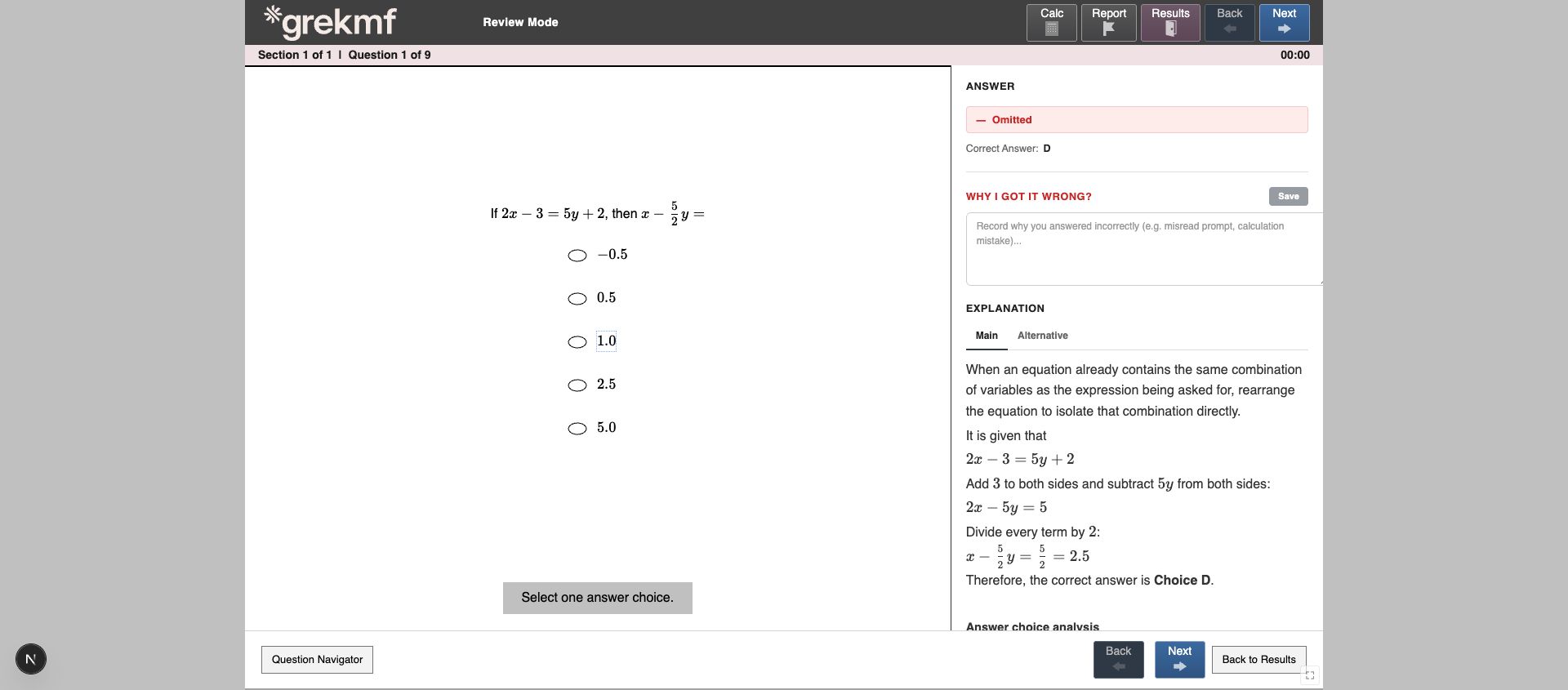
It is given that $2x - 3 = 5y + 2$, and the goal is to find the value of $x - \frac{5}{2} y$.
Isolate the target expression
Step 1: Move the constant terms to produce a relation between $2x$ and $5y$. Add $3$ to both sides:
$2x = 5y + 5$.
Step 2: Subtract $5y$ from both sides:
$2x - 5y = 5$.
Step 3: Divide both sides by $2$:
$x - \frac{5}{2} y = \frac{5}{2} = 2.5$.
Check against the choices
Choice D: $2.5$ matches the value of $x - \frac{5}{2} y$.
Choice A: $-0.5$ could come from dividing $5$ by $-10$, or from an arithmetic sign error when moving constants.
Choice B: $0.5$ is $\frac{1}{2}$, which might result from dividing by $10$ instead of by $2$, or confusing $\frac{5}{2}$ with its reciprocal.
Choice C: $1.0$ might come from incorrectly concluding that $2x - 5y = 2$ and then dividing by $2$.
Choice E: $5.0$ is the value of $2x - 5y$ before dividing by $2$; stopping one step early produces this trap.
Things to Remember:
- To evaluate a linear combination, rearrange the given equation until that combination appears, then scale.
- Dividing an equation by $2$ halves every term, including the constant on the right.
- Stopping before the final division often produces a distractor equal to twice the correct answer.
Question 2 · GREKMF #8481
medium · tc 1blank
Show correct answer and full Premium explanation
Correct answer: A
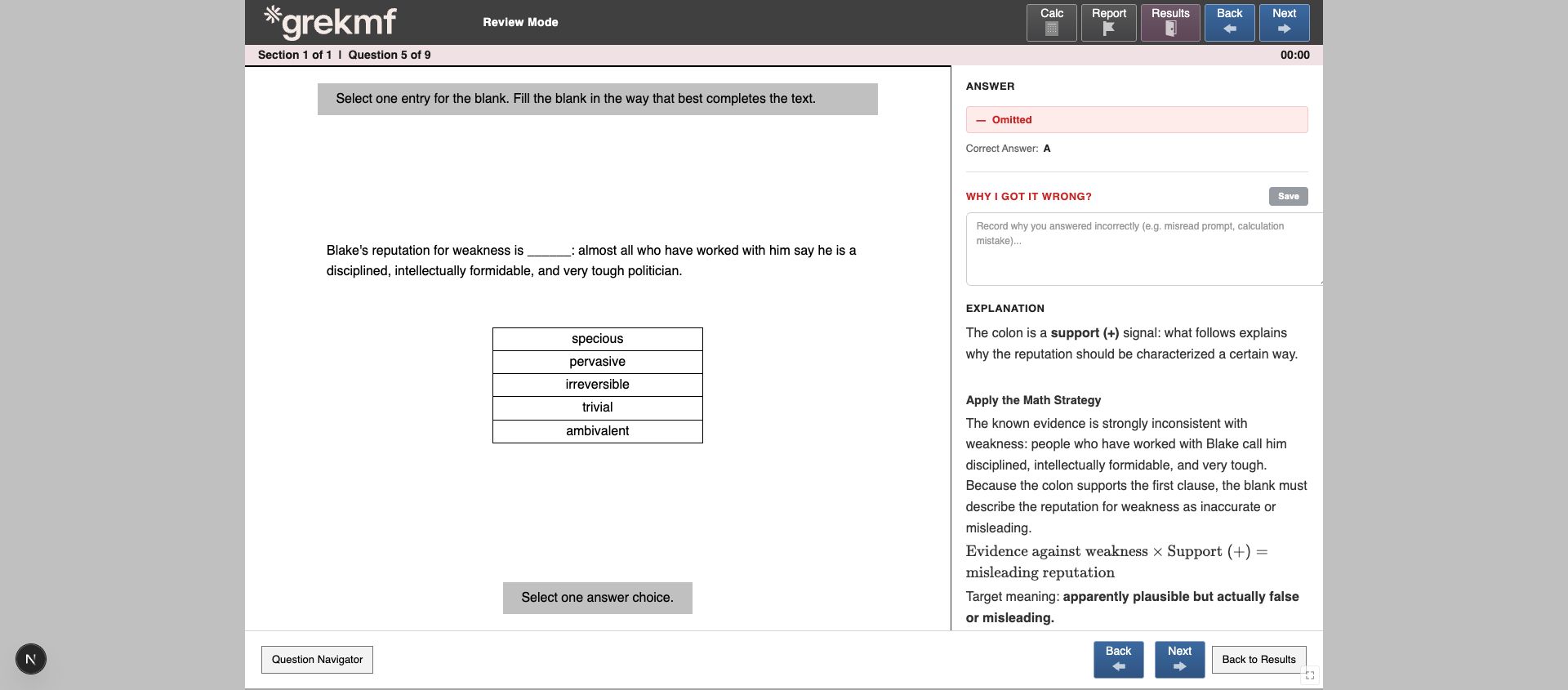
The colon is a support (+) signal: what follows explains why the reputation should be characterized a certain way.
Apply the Math Strategy
The known evidence is strongly inconsistent with weakness: people who have worked with Blake call him disciplined, intellectually formidable, and very tough. Because the colon supports the first clause, the blank must describe the reputation for weakness as inaccurate or misleading.
$\text{Evidence against weakness} \times \text{Support (+)} = \text{misleading reputation}$
Target meaning: apparently plausible but actually false or misleading.
Answer choice analysis
Specious — Correct. “Specious” means superficially plausible but actually false or misleading, exactly matching a reputation contradicted by direct experience.
Pervasive means widespread. The issue is the reputation’s accuracy, not how widely it is held.
Irreversible means impossible to undo. Nothing suggests the reputation cannot change.
Trivial means unimportant. The evidence challenges whether the reputation is true, not whether it matters.
Ambivalent means mixed or conflicted. That does not describe the relation between the reputation and the evidence.
Things to Remember:
- A colon commonly signals support: the material after it explains or justifies what comes before.
- Derive the blank’s target meaning from sentence logic before comparing vocabulary choices.
Question 3 · GREKMF #1206
medium · rc single select
Show correct answer and full Premium explanation
Correct answer: C
Passage Map
Rephrasing
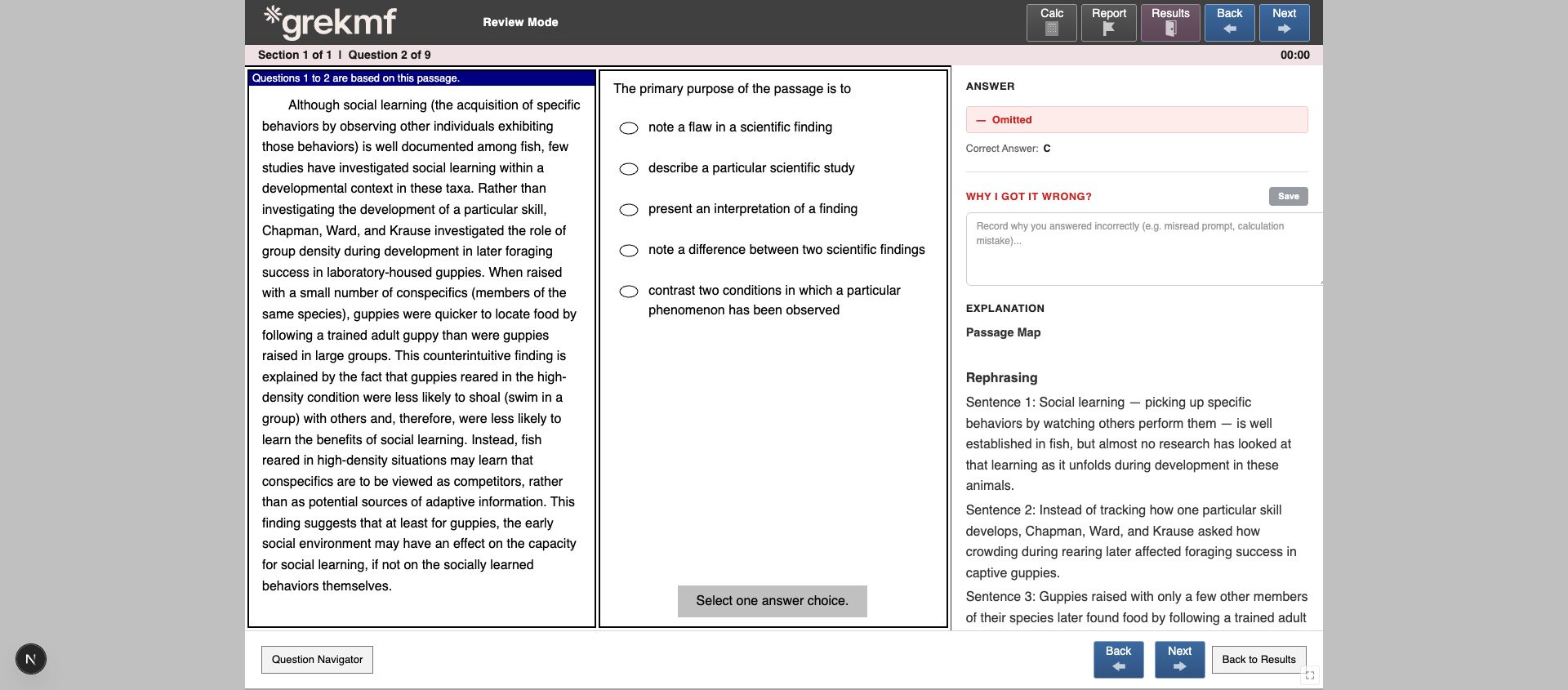
Sentence 1: Social learning — picking up specific behaviors by watching others perform them — is well established in fish, but almost no research has looked at that learning as it unfolds during development in these animals.
Sentence 2: Instead of tracking how one particular skill develops, Chapman, Ward, and Krause asked how crowding during rearing later affected foraging success in captive guppies.
Sentence 3: Guppies raised with only a few other members of their species later found food by following a trained adult faster than guppies raised in crowded groups.
Sentence 4: The surprising result is accounted for by the fact that crowded-reared guppies were less likely to swim in a group, and so were less likely to discover that watching others pays off.
Sentence 5: Crowded-reared fish may instead come to treat other guppies as rivals rather than as useful sources of information.
Sentence 6: The result implies that, at least in guppies, early social conditions can change how well animals can learn from others, even if they do not change the actual socially learned behaviors.
Simplifying
Sentence 1: Fish social learning studied; development almost not.
Sentence 2: Study: rearing density → later foraging.
Sentence 3: Small groups learned faster (surprising).
Sentence 4: Crowding reduced shoaling, hence social learning.
Sentence 5: Crowded fish treat others as competitors.
Sentence 6: Early environment affects capacity to learn socially.
Sentence Function
Sentence 1: Concedes that social learning in fish is already known, then flags the gap (almost no developmental work) that the rest of the passage will fill.
Sentence 2: Introduces the specific study that addresses that gap.
Sentence 3: Reports the study’s key finding.
Sentence 4: Interprets why the finding is counterintuitive — crowding reduced shoaling and therefore social learning.
Sentence 5: Extends the interpretation: crowded fish recast conspecifics as competitors rather than informants.
Sentence 6: Delivers the author’s committed takeaway — early social environment can affect the capacity for social learning. This is the last claim the passage does not walk back; Sentences 2–5 support it as evidence.
Identify and rephrase the question
All five choices open with verbs ("note," "describe," "present," "note," "contrast") — this is a Primary Purpose question. Rephrased: "What is the author mainly doing?"
Vertical Verb Scan
Reading down the verb column first: "note a flaw" requires the author to treat a finding as defective — but Sentences 4–6 accept the result and explain it, so that verb is too hostile. "Describe" is possible but generic: it covers Sentences 2–3 and ignores the interpretive payoff in 4–6. "Note a difference" implies two independent scientific findings; the passage has one study. "Contrast" overweights the two rearing densities, which are experimental conditions inside the study, not the author’s purpose. "Present" survives: it matches an author who reports a finding in order to explain it.
Answer Logic & Critical Thinking
The function map is concession (gap) → study → finding → interpretation → takeaway. A primary-purpose answer must match that whole pattern, not one local comparison. The author’s real work begins at Sentence 4 ("this counterintuitive finding is explained by") and closes at Sentence 6 ("this finding suggests"). That is presenting an interpretation of a finding, not merely describing a study or contrasting two rearing conditions.
Answer choice analysis
(Choice A) "Note a flaw in a scientific finding." Contradicts the passage — Sentences 4–6 treat the result as real and explain it; nothing is called flawed or invalid. The verb "note a flaw" fails the Vertical Verb Scan.
(Choice B) "Describe a particular scientific study." Too generic for the map. Sentences 2–3 do describe Chapman, Ward, and Krause, but that description is a means: the passage exists to explain why the result is counterintuitive and what it implies (Sentences 4–6). No evidence that description itself is the purpose.
(Choice C) Correct. Matches Sentences 4–6: the author reports a finding in order to interpret it (reduced shoaling; conspecifics as competitors) and to draw a developmental implication. That is what the author is mainly doing.
(Choice D) "Note a difference between two scientific findings." No evidence — the passage discusses one study and one result, not two competing findings.
(Choice E) "Contrast two conditions in which a particular phenomenon has been observed." The two densities appear in Sentence 3 as experimental conditions, not as the author’s purpose. Treating that local contrast as the whole point underweights Sentences 4–6. This is a no evidence case for purpose (the contrast is a detail, not the job of the passage).
Things to Remember:
- When every choice opens with a verb, scan the verb column first: hostile verbs ("note a flaw," "refute") need a textual attack, and overly generic verbs ("describe") often miss the interpretive payoff.
- Primary purpose tracks the pattern of sentence functions across the whole map, not a single comparison or method detail inside the study.
- A passage that reports a result in order to explain it and draw an implication is doing interpretation, not mere description.
Put the method into practice
Build a set around the exact unit costing points
Use GREKMF’s skill filters and performance breakdown to stop guessing what to study next.
Browse practice by skillSources and methodology
Check the primary sources
Frequently asked questions
Narrow enough that one method or error pattern repeats. After the pattern improves, widen the set so you must identify the method yourself.
When you can solve unseen topic questions accurately, explain the process, and maintain it under moderate time pressure.
Yes—especially guesses, slow correct answers, and choices changed without a clear reason.