GRE Reading Comprehension Practice
GRE Reading Comprehension is less about remembering every detail than tracking structure: what each paragraph does, where the author stands, and which sentence supports an answer.
What GRE RC questions ask
You will answer main idea, detail, inference, function, attitude, vocabulary-in-context, and select-all-that-apply questions. Some prompts ask you to select a sentence in the passage.
- Main idea and primary purpose
- Inference and implication
- Paragraph or sentence function
- Author attitude and argument structure
Map, then prove
After each paragraph, summarize its job in a few words. On questions, predict the answer and return to the relevant lines. Treat every choice as a claim that needs proof.
- Separate author views from reported views
- Prefer the narrowest fully supported answer
- For inference, choose what must be true
Common RC traps
Watch for answers that are true in the real world but absent from the passage, distort a relationship, exaggerate with absolute language, or answer a nearby question instead of the one asked.
From the GREKMF question bank
Real questions with Premium explanations
Question 1 · GREKMF #1206
medium · rc single select
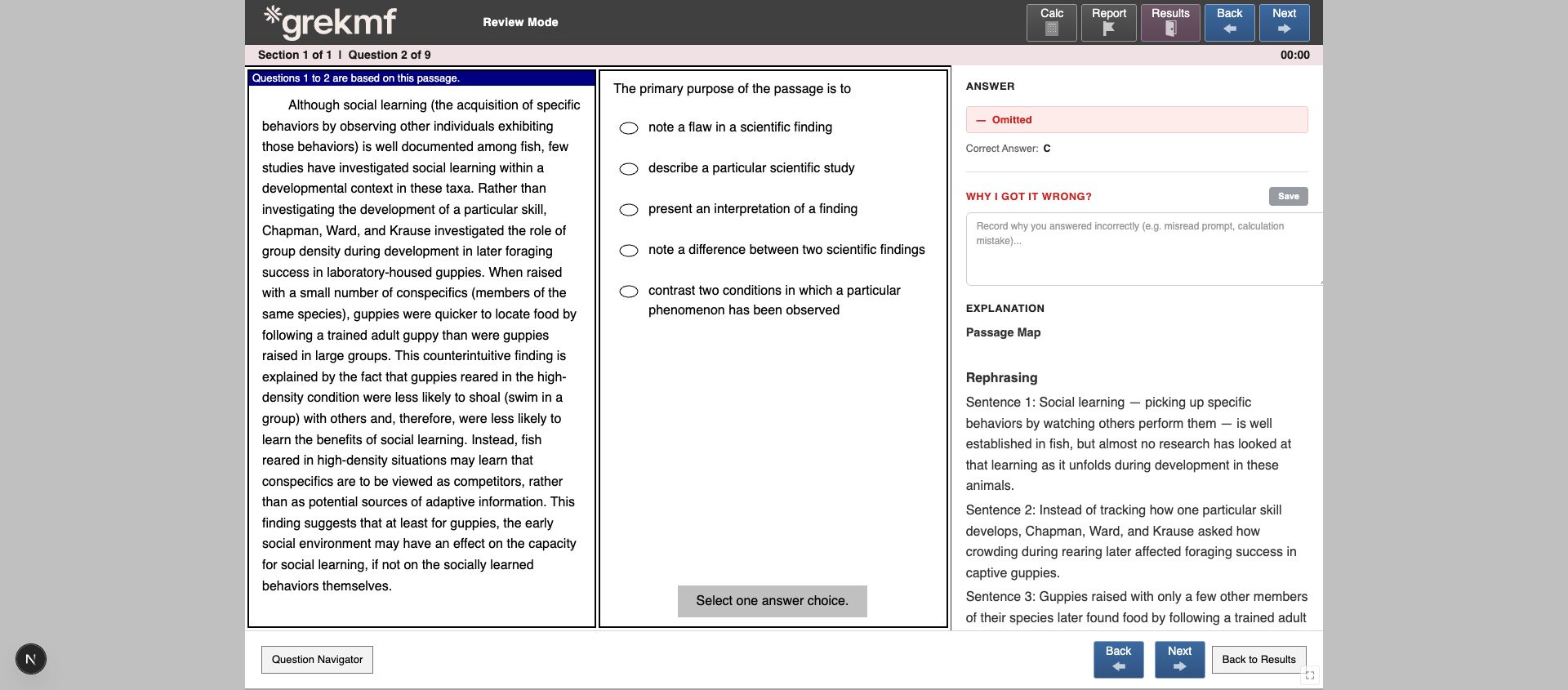
Show correct answer and full Premium explanation
Correct answer: C
Passage Map
Rephrasing
Sentence 1: Social learning — picking up specific behaviors by watching others perform them — is well established in fish, but almost no research has looked at that learning as it unfolds during development in these animals.
Sentence 2: Instead of tracking how one particular skill develops, Chapman, Ward, and Krause asked how crowding during rearing later affected foraging success in captive guppies.
Sentence 3: Guppies raised with only a few other members of their species later found food by following a trained adult faster than guppies raised in crowded groups.
Sentence 4: The surprising result is accounted for by the fact that crowded-reared guppies were less likely to swim in a group, and so were less likely to discover that watching others pays off.
Sentence 5: Crowded-reared fish may instead come to treat other guppies as rivals rather than as useful sources of information.
Sentence 6: The result implies that, at least in guppies, early social conditions can change how well animals can learn from others, even if they do not change the actual socially learned behaviors.
Simplifying
Sentence 1: Fish social learning studied; development almost not.
Sentence 2: Study: rearing density → later foraging.
Sentence 3: Small groups learned faster (surprising).
Sentence 4: Crowding reduced shoaling, hence social learning.
Sentence 5: Crowded fish treat others as competitors.
Sentence 6: Early environment affects capacity to learn socially.
Sentence Function
Sentence 1: Concedes that social learning in fish is already known, then flags the gap (almost no developmental work) that the rest of the passage will fill.
Sentence 2: Introduces the specific study that addresses that gap.
Sentence 3: Reports the study’s key finding.
Sentence 4: Interprets why the finding is counterintuitive — crowding reduced shoaling and therefore social learning.
Sentence 5: Extends the interpretation: crowded fish recast conspecifics as competitors rather than informants.
Sentence 6: Delivers the author’s committed takeaway — early social environment can affect the capacity for social learning. This is the last claim the passage does not walk back; Sentences 2–5 support it as evidence.
Identify and rephrase the question
All five choices open with verbs ("note," "describe," "present," "note," "contrast") — this is a Primary Purpose question. Rephrased: "What is the author mainly doing?"
Vertical Verb Scan
Reading down the verb column first: "note a flaw" requires the author to treat a finding as defective — but Sentences 4–6 accept the result and explain it, so that verb is too hostile. "Describe" is possible but generic: it covers Sentences 2–3 and ignores the interpretive payoff in 4–6. "Note a difference" implies two independent scientific findings; the passage has one study. "Contrast" overweights the two rearing densities, which are experimental conditions inside the study, not the author’s purpose. "Present" survives: it matches an author who reports a finding in order to explain it.
Answer Logic & Critical Thinking
The function map is concession (gap) → study → finding → interpretation → takeaway. A primary-purpose answer must match that whole pattern, not one local comparison. The author’s real work begins at Sentence 4 ("this counterintuitive finding is explained by") and closes at Sentence 6 ("this finding suggests"). That is presenting an interpretation of a finding, not merely describing a study or contrasting two rearing conditions.
Answer choice analysis
(Choice A) "Note a flaw in a scientific finding." Contradicts the passage — Sentences 4–6 treat the result as real and explain it; nothing is called flawed or invalid. The verb "note a flaw" fails the Vertical Verb Scan.
(Choice B) "Describe a particular scientific study." Too generic for the map. Sentences 2–3 do describe Chapman, Ward, and Krause, but that description is a means: the passage exists to explain why the result is counterintuitive and what it implies (Sentences 4–6). No evidence that description itself is the purpose.
(Choice C) Correct. Matches Sentences 4–6: the author reports a finding in order to interpret it (reduced shoaling; conspecifics as competitors) and to draw a developmental implication. That is what the author is mainly doing.
(Choice D) "Note a difference between two scientific findings." No evidence — the passage discusses one study and one result, not two competing findings.
(Choice E) "Contrast two conditions in which a particular phenomenon has been observed." The two densities appear in Sentence 3 as experimental conditions, not as the author’s purpose. Treating that local contrast as the whole point underweights Sentences 4–6. This is a no evidence case for purpose (the contrast is a detail, not the job of the passage).
Things to Remember:
- When every choice opens with a verb, scan the verb column first: hostile verbs ("note a flaw," "refute") need a textual attack, and overly generic verbs ("describe") often miss the interpretive payoff.
- Primary purpose tracks the pattern of sentence functions across the whole map, not a single comparison or method detail inside the study.
- A passage that reports a result in order to explain it and draw an implication is doing interpretation, not mere description.
Question 2 · GREKMF #1207
medium · rc single select
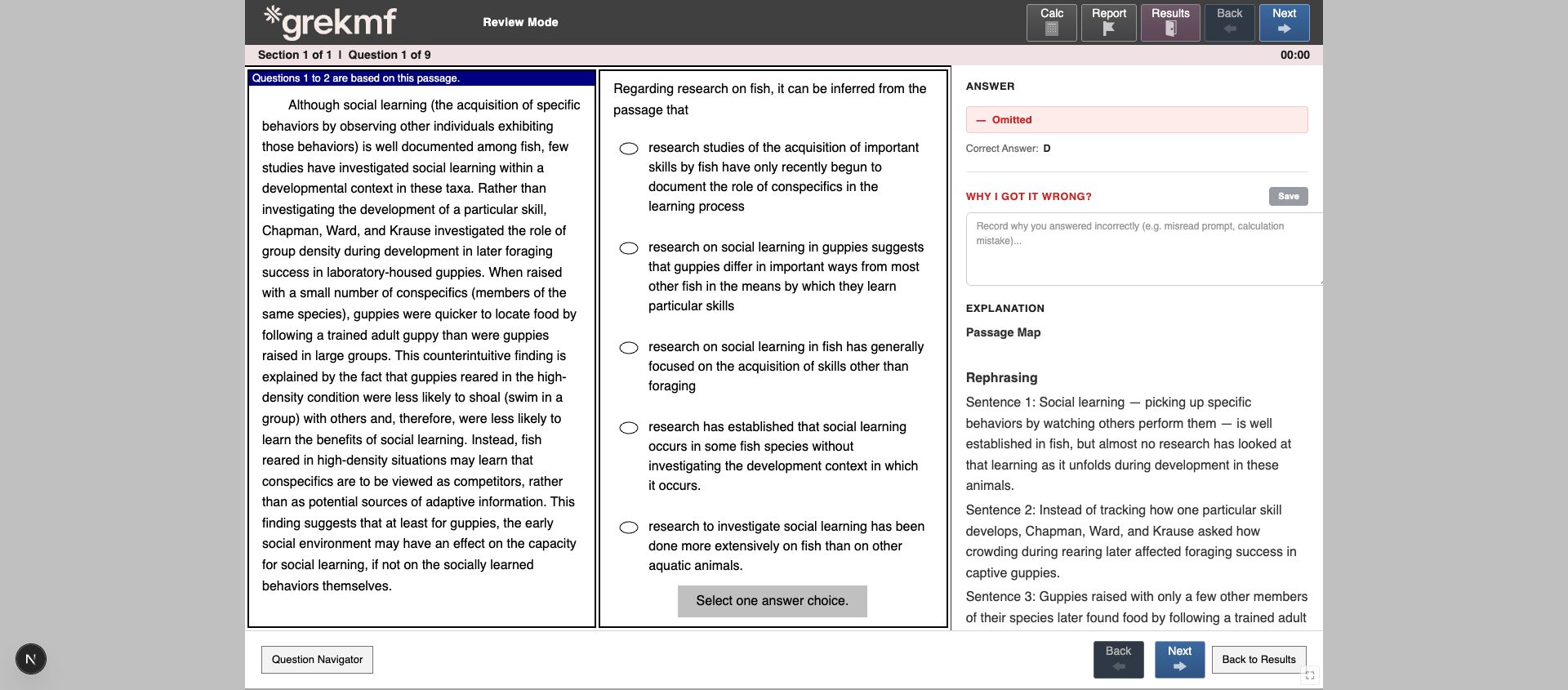
Show correct answer and full Premium explanation
Correct answer: D
Passage Map
Rephrasing
Sentence 1: Social learning — picking up specific behaviors by watching others perform them — is well established in fish, but almost no research has looked at that learning as it unfolds during development in these animals.
Sentence 2: Instead of tracking how one particular skill develops, Chapman, Ward, and Krause asked how crowding during rearing later affected foraging success in captive guppies.
Sentence 3: Guppies raised with only a few other members of their species later found food by following a trained adult faster than guppies raised in crowded groups.
Sentence 4: The surprising result is accounted for by the fact that crowded-reared guppies were less likely to swim in a group, and so were less likely to discover that watching others pays off.
Sentence 5: Crowded-reared fish may instead come to treat other guppies as rivals rather than as useful sources of information.
Sentence 6: The result implies that, at least in guppies, early social conditions can change how well animals can learn from others, even if they do not change the actual socially learned behaviors.
Simplifying
Sentence 1: Fish social learning known; development almost not studied.
Sentence 2: Study: rearing density → later foraging.
Sentence 3: Small groups learned faster (surprising).
Sentence 4: Crowding reduced shoaling, hence social learning.
Sentence 5: Crowded fish treat others as competitors.
Sentence 6: Early environment affects capacity to learn socially.
Sentence Function
Sentence 1: Concedes that social learning in fish is already known, then flags the developmental-research gap.
Sentence 2: Introduces the study that addresses that gap.
Sentence 3: Reports the study’s key finding.
Sentence 4: Interprets why the finding is counterintuitive.
Sentence 5: Extends the interpretation: crowded fish recast conspecifics as competitors.
Sentence 6: Author’s committed takeaway — early social environment can affect the capacity for social learning.
Identify and rephrase the question
"It can be inferred" makes this a Thinking — Inference question. Rephrased: "What can be concluded about research on fish, though not quoted verbatim?"
Answer Logic & Critical Thinking
Under the Word of Zeus, treat Sentence 1 as fully true. It pairs two facts: social learning is well documented among fish, and few studies have examined it in a developmental context. The one-step inference is that researchers have already established that social learning occurs in some fish species without having investigated the developmental setting in which it occurs.
Answer choice analysis
(Choice A) "Research studies of the acquisition of important skills by fish have only recently begun to document the role of conspecifics." No evidence for "only recently," and Sentence 1 actually says social learning is already well documented. One-Word Elimination on "recently."
(Choice B) "Research on social learning in guppies suggests that guppies differ in important ways from most other fish." No evidence — Sentence 6 limits the implication to guppies ("at least for guppies") but never compares their learning mechanism with that of other fish. One-Word Elimination on "differ."
(Choice C) "Research on social learning in fish has generally focused on the acquisition of skills other than foraging." No evidence — Sentence 2’s "rather than investigating the development of a particular skill" describes Chapman et al.’s design, not a field-wide avoidance of foraging.
(Choice D) Correct. Direct one-step reading of Sentence 1: social learning is well documented in fish, yet developmental context has rarely been studied. That is the inference the stem asks for.
(Choice E) "Research to investigate social learning has been done more extensively on fish than on other aquatic animals." No evidence — the passage never compares fish with other aquatic animals.
Things to Remember:
- An inference must be a one-step conclusion from a stated sentence, not a new comparison or a timing claim the passage never makes.
- Kill choices on a single overstated word ("recently," "differ," "more extensively") when that word has no sentence behind it.
- A concession-plus-gap opening ("although X is well documented, few studies have done Y") often licenses exactly the inference that X is established without Y.
Question 3 · GREKMF #1209
medium · rc single select
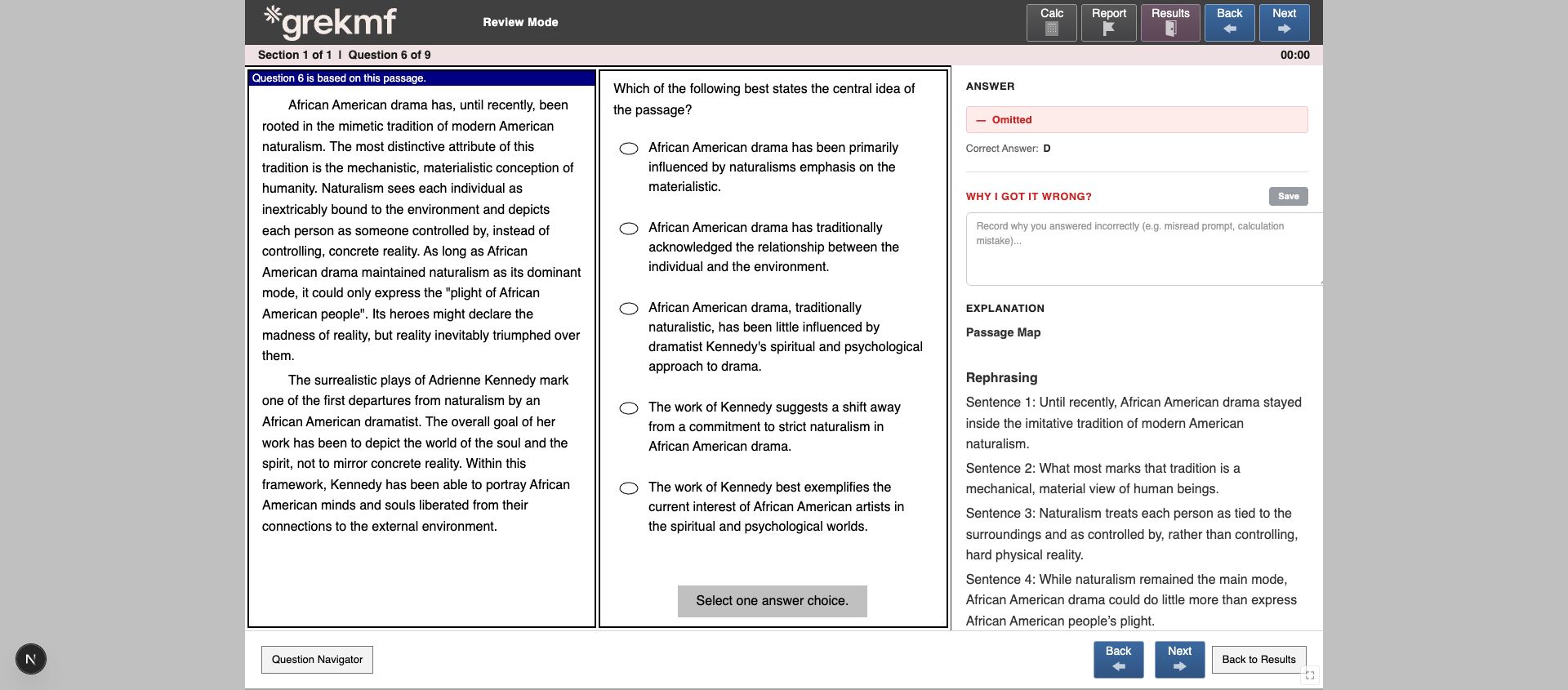
Show correct answer and full Premium explanation
Correct answer: D
Passage Map
Rephrasing
Sentence 1: Until recently, African American drama stayed inside the imitative tradition of modern American naturalism.
Sentence 2: What most marks that tradition is a mechanical, material view of human beings.
Sentence 3: Naturalism treats each person as tied to the surroundings and as controlled by, rather than controlling, hard physical reality.
Sentence 4: While naturalism remained the main mode, African American drama could do little more than express African American people’s plight.
Sentence 5: Its protagonists might call reality insane, but reality always won.
Sentence 6: Adrienne Kennedy’s surrealist plays are among the first times an African American playwright has left naturalism behind.
Sentence 7: Her aim has been to show the soul and spirit, not to copy concrete reality.
Sentence 8: Working in that frame, she has been able to show African American minds and souls freed from their ties to the outside world.
Simplifying
Sentence 1: Until recently, naturalistic tradition.
Sentence 2: Mechanical, material view of humans.
Sentence 3: Environment controls the person.
Sentence 4: Naturalism confined drama to “plight.”
Sentence 5: Reality always defeats the hero.
Sentence 6: Kennedy is an early break from naturalism.
Sentence 7: She aims at soul/spirit, not surface reality.
Sentence 8: That lets her show minds freed from environment.
Sentence Function
Sentence 1: States the long-standing naturalistic baseline (“until recently”) that the passage will then leave behind.
Sentence 2: Defines the tradition named in Sentence 1.
Sentence 3: Elaborates naturalism’s individual–environment claim.
Sentence 4: Shows what that mode cost African American drama.
Sentence 5: Reinforces the limitation: reality triumphs over the hero.
Sentence 6: Delivers the author’s central pivot — Kennedy marks one of the first departures from naturalism. Later sentences support this claim; none walk it back.
Sentence 7: Explains what Kennedy does instead of naturalism.
Sentence 8: Shows the payoff of that alternative framework.
Identify and rephrase the question
"Best states the central idea" is a Big Idea — Main Idea question. Rephrased: "What is the author's central point?"
Answer Logic & Critical Thinking
Sentence 6 carries the main-idea tag: it is the claim the rest of the second paragraph supports and that Sentence 1’s "until recently" already prepares. A correct central-idea choice must cover both the naturalistic baseline (Sentences 1–5) and Kennedy’s departure (Sentences 6–8), not just one paragraph.
Answer choice analysis
(Choice A) "African American drama has been primarily influenced by naturalism’s emphasis on the materialistic." Too narrow: it restates Sentences 1–2 and ignores the Kennedy pivot. No evidence that materialism-as-influence is the whole point.
(Choice B) "African American drama has traditionally acknowledged the relationship between the individual and the environment." Too narrow: it restates Sentence 3 only. No evidence that this acknowledgment is the central idea.
(Choice C) "...has been little influenced by dramatist Kennedy's spiritual and psychological approach." Contradicts the passage — Sentence 6 presents Kennedy as a pioneering departure. One-Word Elimination on "little."
(Choice D) Correct. Matches Sentence 1’s "until recently" naturalistic commitment plus Sentence 6’s shift away from strict naturalism — the full map.
(Choice E) "The work of Kennedy best exemplifies the current interest of African American artists in the spiritual and psychological worlds." No evidence for a broad current interest among African American artists, or for "best exemplifies." Sentence 6 only says she is one of the first dramatists to leave naturalism.
Things to Remember:
- A main-idea answer must cover the passage’s major sections, not only the opening tradition or only one supporting detail.
- "Until recently" plus a named first departure is a classic old-baseline / new-pivot main-idea structure.
- A single undercutting word such as "little" can reverse an otherwise topic-relevant choice.
Put the method into practice
Practice in GREKMF’s exam-like question bank
Move from the guide to a focused set, then review detailed explanations and skill-level performance. The KMF 1000 Quant series is free and requires no card.
Start free GRE practiceFrequently asked questions
Usually read the passage first so you understand its structure. A quick glance can help on very short passages, but avoid hunting isolated keywords without context.
Read actively enough to build a map. The goal is not maximum speed; it is fewer rereads and evidence-based answers.
Evaluate every choice independently. Select all and only the statements directly supported by the passage.