GRE Verbal Study Plan
Verbal improves when three systems grow together: usable vocabulary, sentence logic, and passage evidence. Build vocabulary and Reading Comprehension from day one, then increase TC and SE volume as the word base becomes useful.
960
Vocab Mountain words
Thirty words across 32 cumulative groups.
3
Question families
RC, Text Completion, and Sentence Equivalence.
30 min
Daily vocabulary
New group plus cumulative retrieval.
The working method
A sequence you can repeat
Start vocabulary and RC immediately
Vocabulary needs spacing; RC reasoning improves through frequent, smaller sessions.
Learn sentence logic before chasing obscure words
Mark contrast, continuation, cause, concession, tone, and blank relationships.
Add heavier TC and SE after a vocabulary base forms
Predict first, then use choices to refine—not replace—the reasoning.
Time short sets before full sections
Preserve evidence and prediction habits as the clock becomes stricter.
Vocabulary: convert recognition into retrieval
Seeing a definition and thinking ‘I knew that’ is not enough. Hide the meaning, retrieve it, connect the word to a synonym family or contrast, and revisit forgotten words more often. Use Vocab Mountain for one new 30-word group plus cumulative review.
Reading Comprehension: map function, then prove
Summarize the job of each paragraph rather than memorizing every detail. Separate the author’s view from views merely reported, identify pivots, and require a line or logical consequence for every answer. For inference questions, choose what must follow—not what might be true in the world.
- Main point and purpose
- Paragraph or sentence function
- Inference
- Author attitude
- Argument structure
Text Completion and Sentence Equivalence: predict before choices
In TC, solve the blank with the strongest clue and test all blanks as one coherent sentence. In SE, the two choices must both fit and create equivalent completed meanings. A synonym pair that violates the sentence logic is a trap, not a shortcut.
Review Verbal at the clue level
For every miss, record the exact connective, word, sentence, or scope limit that decided the answer. Then explain why the attractive wrong choice fails. Re-reading an explanation without identifying the decisive evidence rarely changes the next attempt.
A repeatable Verbal week
Keep vocabulary daily. Alternate RC-focused days with TC/SE-focused days, but include a small amount of the other family so retrieval stays spaced. End the week with a mixed timed set and a slower review session that revisits old red words and unresolved passage errors.
Measure more than accuracy. For RC, track rereads, unsupported inferences, and time per passage. For TC and SE, track missed logic signals, prediction quality, unknown vocabulary, and choices selected because they merely sounded familiar.
- Daily vocabulary retrieval
- Three or four short RC sessions
- Prediction-first TC and SE
- One mixed checkpoint
- One delayed-review block
Reading volume helps only when it trains GRE behaviors
Reading serious material can improve comfort with dense prose, but passive reading is not a substitute for question review. When using outside articles, identify the thesis, paragraph functions, concessions, evidence, and author attitude. Summarize the structure in a few lines rather than collecting facts.
If outside reading consumes time needed for real RC questions, reduce it. The exam rewards precise claims supported by a finite passage, so your plan must include repeated practice eliminating choices that are broader, stronger, or slightly different from the text.
Once per week, explain one passage aloud without looking: the author’s main claim, the role of each paragraph, and the evidence for the hardest answer. If the explanation becomes vague, return to the exact lines rather than rereading the entire passage indiscriminately.
From the GREKMF question bank
Real questions with Premium explanations
Question 1 · GREKMF #8481
medium · tc 1blank
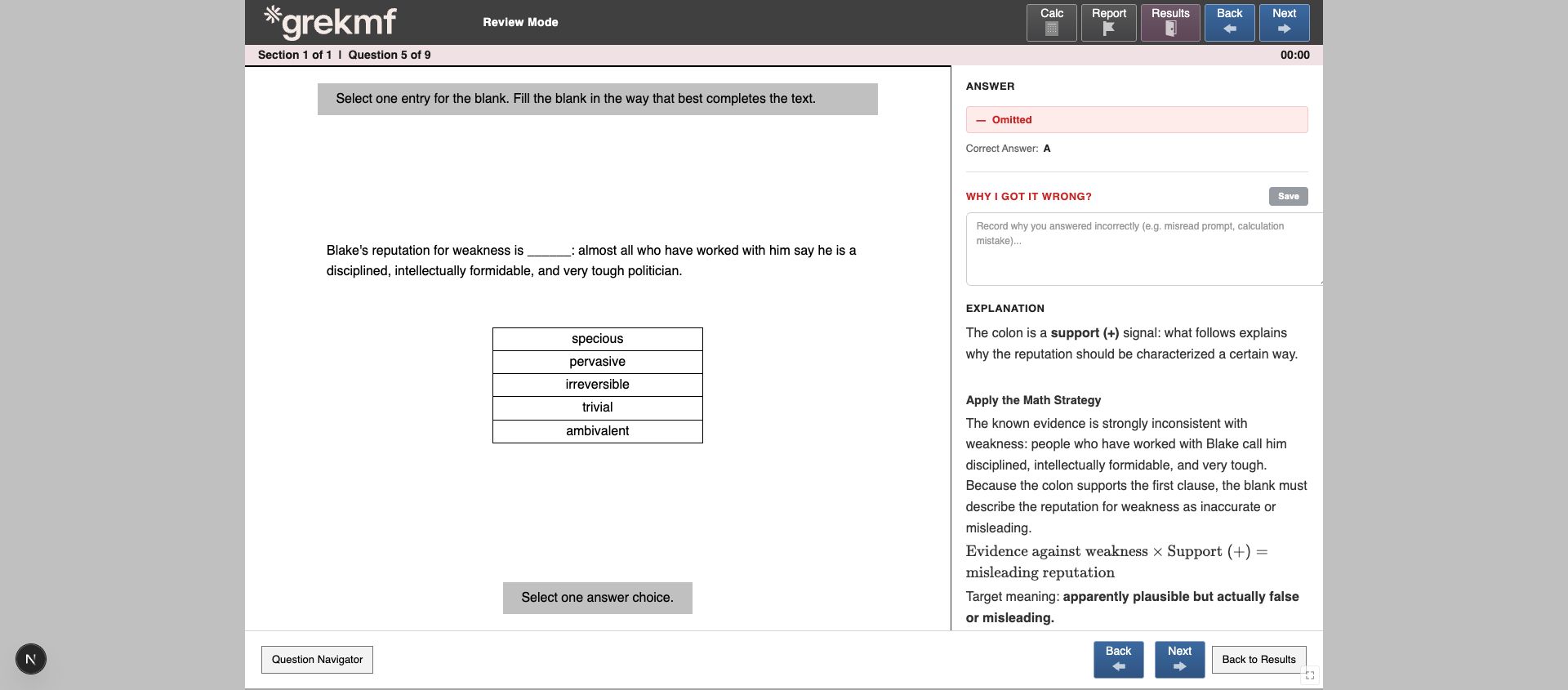
Show correct answer and full Premium explanation
Correct answer: A
The colon is a support (+) signal: what follows explains why the reputation should be characterized a certain way.
Apply the Math Strategy
The known evidence is strongly inconsistent with weakness: people who have worked with Blake call him disciplined, intellectually formidable, and very tough. Because the colon supports the first clause, the blank must describe the reputation for weakness as inaccurate or misleading.
$\text{Evidence against weakness} \times \text{Support (+)} = \text{misleading reputation}$
Target meaning: apparently plausible but actually false or misleading.
Answer choice analysis
Specious — Correct. “Specious” means superficially plausible but actually false or misleading, exactly matching a reputation contradicted by direct experience.
Pervasive means widespread. The issue is the reputation’s accuracy, not how widely it is held.
Irreversible means impossible to undo. Nothing suggests the reputation cannot change.
Trivial means unimportant. The evidence challenges whether the reputation is true, not whether it matters.
Ambivalent means mixed or conflicted. That does not describe the relation between the reputation and the evidence.
Things to Remember:
- A colon commonly signals support: the material after it explains or justifies what comes before.
- Derive the blank’s target meaning from sentence logic before comparing vocabulary choices.
Question 2 · GREKMF #8001
medium · se
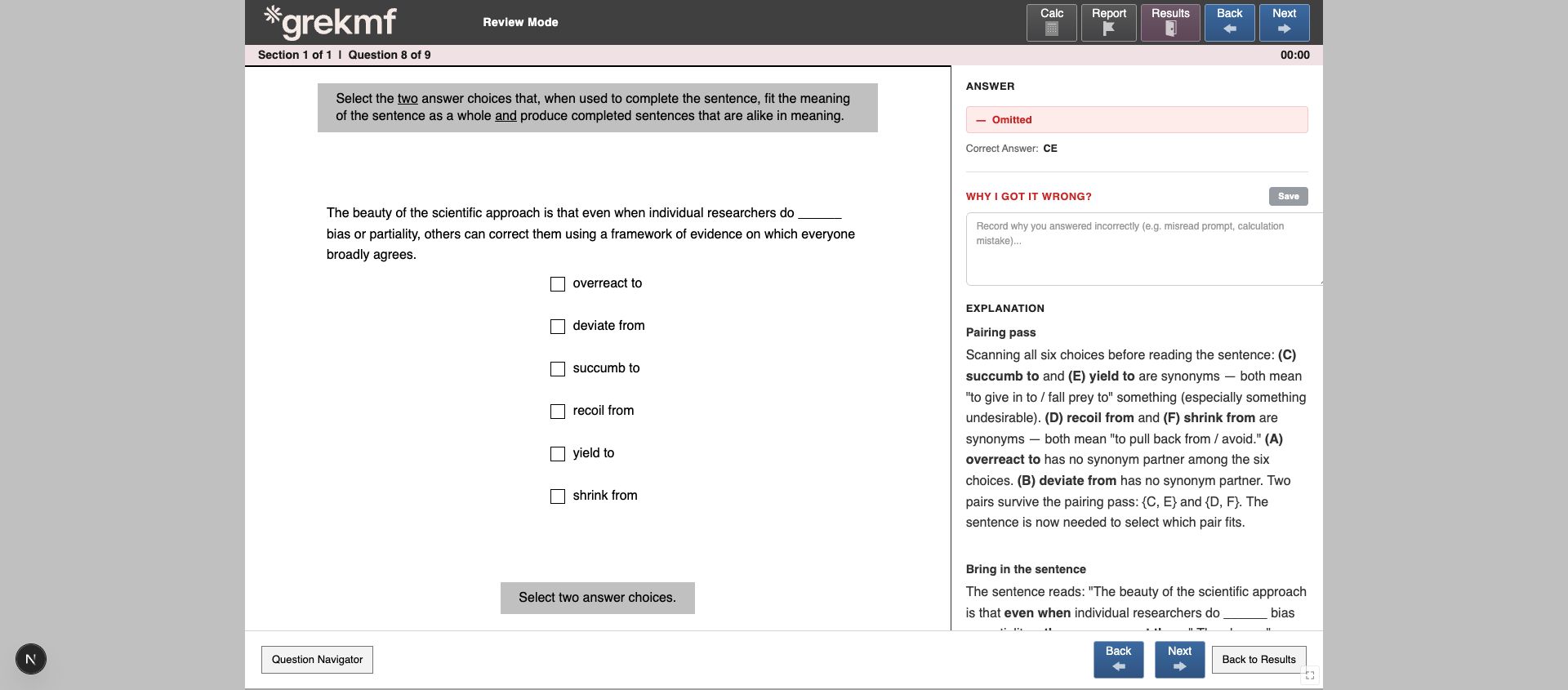
Show correct answer and full Premium explanation
Correct answer: CE
Pairing pass
Scanning all six choices before reading the sentence: (C) succumb to and (E) yield to are synonyms — both mean "to give in to / fall prey to" something (especially something undesirable). (D) recoil from and (F) shrink from are synonyms — both mean "to pull back from / avoid." (A) overreact to has no synonym partner among the six choices. (B) deviate from has no synonym partner. Two pairs survive the pairing pass: {C, E} and {D, F}. The sentence is now needed to select which pair fits.
Bring in the sentence
The sentence reads: "The beauty of the scientific approach is that even when individual researchers do ______ bias or partiality, others can correct them." The phrase "even when... others can correct them" is a concessive structure: it acknowledges that researchers sometimes exhibit bias — and that the system has a correction mechanism for it. The blank must describe something the researchers are doing to bias — something that requires external correction. Giving in to bias (pair {C, E}) creates a problem to be corrected. Avoiding bias (pair {D, F}) creates no problem at all — there would be nothing to correct. Pair {C, E} is the only pair consistent with the sentence's logic.
Answer choice analysis
(Choice A) overreact to — no synonym partner among the six choices; eliminated on the pairing pass alone.
(Choice B) deviate from — no synonym partner among the six choices; eliminated on the pairing pass alone.
(Choice C) succumb to — Correct. Means "to give in to" bias — researchers who succumb to bias create an error that others can correct, which is exactly what the sentence describes.
(Choice D) recoil from — paired with "shrink from," but both mean to avoid bias. If researchers avoid bias, they haven't done anything wrong and there is nothing for others to correct. Contradicts the sentence's logic.
(Choice E) yield to — Correct. A direct synonym of "succumb to" in this context, meaning "to give way to" bias. Forms the correct pair with Choice C.
(Choice F) shrink from — paired with "recoil from," same problem: both mean avoidance of bias, leaving nothing to correct. Contradicts the sentence's logic.
Things to Remember:
- Always complete the pairing pass before reading the sentence — any word without a synonym partner cannot be part of the correct answer and is eliminated immediately.
- When two pairs survive the pairing pass, read the full sentence structure to determine which pair is logically consistent — here, the concessive clause "even when... others can correct them" signals that the researchers are doing something problematic, selecting the "give in to" pair over the "avoid" pair.
- Two words can be near-synonyms in isolation but point in completely opposite directions when inserted into the sentence ("succumb to bias" vs. "recoil from bias") — always verify the direction of the phrase, not just the word in isolation.
Question 3 · GREKMF #1206
medium · rc single select
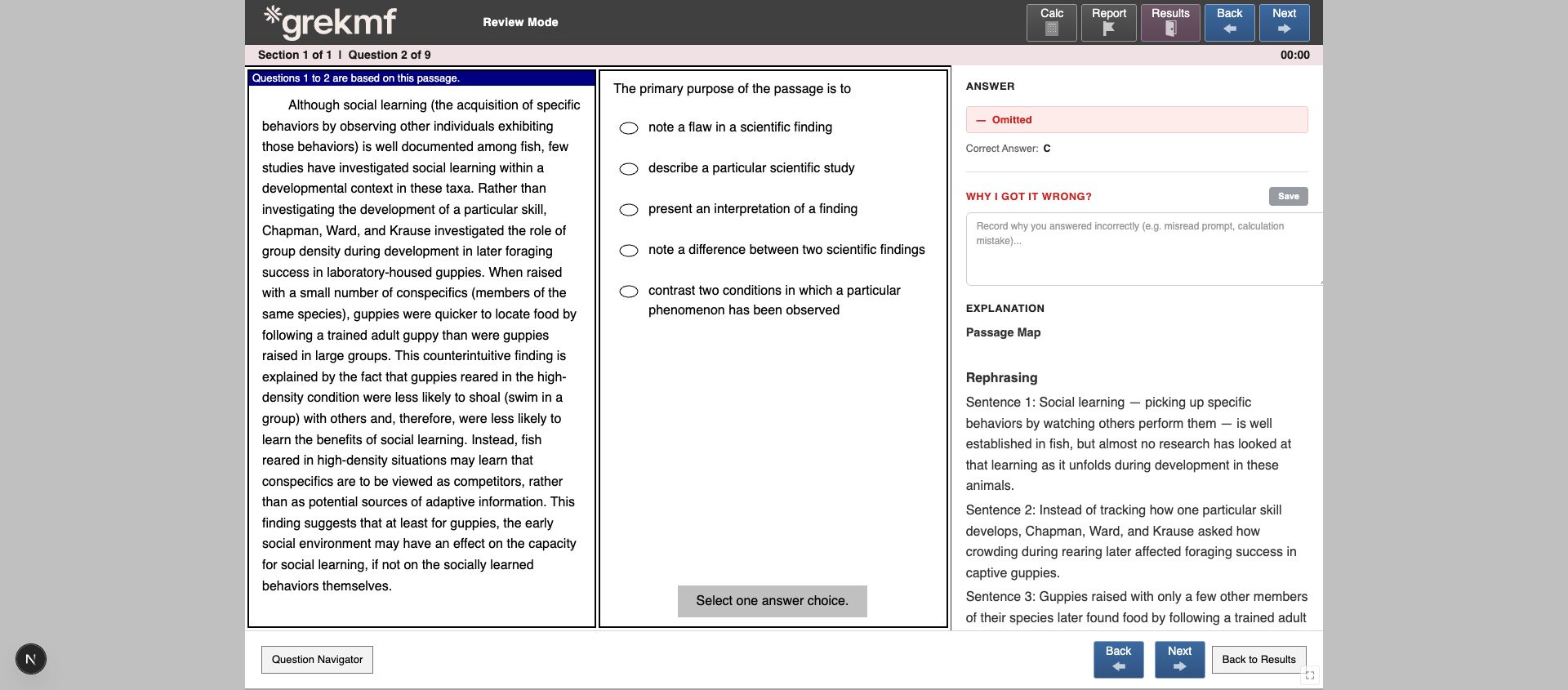
Show correct answer and full Premium explanation
Correct answer: C
Passage Map
Rephrasing
Sentence 1: Social learning — picking up specific behaviors by watching others perform them — is well established in fish, but almost no research has looked at that learning as it unfolds during development in these animals.
Sentence 2: Instead of tracking how one particular skill develops, Chapman, Ward, and Krause asked how crowding during rearing later affected foraging success in captive guppies.
Sentence 3: Guppies raised with only a few other members of their species later found food by following a trained adult faster than guppies raised in crowded groups.
Sentence 4: The surprising result is accounted for by the fact that crowded-reared guppies were less likely to swim in a group, and so were less likely to discover that watching others pays off.
Sentence 5: Crowded-reared fish may instead come to treat other guppies as rivals rather than as useful sources of information.
Sentence 6: The result implies that, at least in guppies, early social conditions can change how well animals can learn from others, even if they do not change the actual socially learned behaviors.
Simplifying
Sentence 1: Fish social learning studied; development almost not.
Sentence 2: Study: rearing density → later foraging.
Sentence 3: Small groups learned faster (surprising).
Sentence 4: Crowding reduced shoaling, hence social learning.
Sentence 5: Crowded fish treat others as competitors.
Sentence 6: Early environment affects capacity to learn socially.
Sentence Function
Sentence 1: Concedes that social learning in fish is already known, then flags the gap (almost no developmental work) that the rest of the passage will fill.
Sentence 2: Introduces the specific study that addresses that gap.
Sentence 3: Reports the study’s key finding.
Sentence 4: Interprets why the finding is counterintuitive — crowding reduced shoaling and therefore social learning.
Sentence 5: Extends the interpretation: crowded fish recast conspecifics as competitors rather than informants.
Sentence 6: Delivers the author’s committed takeaway — early social environment can affect the capacity for social learning. This is the last claim the passage does not walk back; Sentences 2–5 support it as evidence.
Identify and rephrase the question
All five choices open with verbs ("note," "describe," "present," "note," "contrast") — this is a Primary Purpose question. Rephrased: "What is the author mainly doing?"
Vertical Verb Scan
Reading down the verb column first: "note a flaw" requires the author to treat a finding as defective — but Sentences 4–6 accept the result and explain it, so that verb is too hostile. "Describe" is possible but generic: it covers Sentences 2–3 and ignores the interpretive payoff in 4–6. "Note a difference" implies two independent scientific findings; the passage has one study. "Contrast" overweights the two rearing densities, which are experimental conditions inside the study, not the author’s purpose. "Present" survives: it matches an author who reports a finding in order to explain it.
Answer Logic & Critical Thinking
The function map is concession (gap) → study → finding → interpretation → takeaway. A primary-purpose answer must match that whole pattern, not one local comparison. The author’s real work begins at Sentence 4 ("this counterintuitive finding is explained by") and closes at Sentence 6 ("this finding suggests"). That is presenting an interpretation of a finding, not merely describing a study or contrasting two rearing conditions.
Answer choice analysis
(Choice A) "Note a flaw in a scientific finding." Contradicts the passage — Sentences 4–6 treat the result as real and explain it; nothing is called flawed or invalid. The verb "note a flaw" fails the Vertical Verb Scan.
(Choice B) "Describe a particular scientific study." Too generic for the map. Sentences 2–3 do describe Chapman, Ward, and Krause, but that description is a means: the passage exists to explain why the result is counterintuitive and what it implies (Sentences 4–6). No evidence that description itself is the purpose.
(Choice C) Correct. Matches Sentences 4–6: the author reports a finding in order to interpret it (reduced shoaling; conspecifics as competitors) and to draw a developmental implication. That is what the author is mainly doing.
(Choice D) "Note a difference between two scientific findings." No evidence — the passage discusses one study and one result, not two competing findings.
(Choice E) "Contrast two conditions in which a particular phenomenon has been observed." The two densities appear in Sentence 3 as experimental conditions, not as the author’s purpose. Treating that local contrast as the whole point underweights Sentences 4–6. This is a no evidence case for purpose (the contrast is a detail, not the job of the passage).
Things to Remember:
- When every choice opens with a verb, scan the verb column first: hostile verbs ("note a flaw," "refute") need a textual attack, and overly generic verbs ("describe") often miss the interpretive payoff.
- Primary purpose tracks the pattern of sentence functions across the whole map, not a single comparison or method detail inside the study.
- A passage that reports a result in order to explain it and draw an implication is doing interpretation, not mere description.
Put the method into practice
Practice in GREKMF’s exam-like question bank
Move from the guide to a focused set, then review detailed explanations and skill-level performance. The KMF 1000 Quant series is free and requires no card.
Start Verbal practiceSources and methodology
Check the primary sources
Frequently asked questions
No. Begin RC immediately and use light TC/SE practice while vocabulary grows. Increase TC/SE volume after several groups.
Vocab Mountain uses 30-word groups. Reserve about 30 minutes for a new group and cumulative retrieval rather than racing through more words.
After your prediction and evidence processes are stable, time short sets, then full sections. Do not sacrifice the process simply to finish.