KMF 1000 Quant Guide
KMF 1000 is not valuable because you can finish 1,000 questions. It is valuable because 37 structured pairs let you repeat a disciplined cycle: solve, review, classify, repair, revisit, and verify on unseen work.
37
Paired sets
A Base block followed by a Hard block.
12 + 15
Questions per pair
27 questions when both halves are completed.
21 + 26 min
Official-style timing
Forty-seven total timed minutes.
The working method
A sequence you can repeat
Take a Base half with a clean method
Work untimed at first if necessary; name the concept and constraints before calculating.
Use the Hard half to test transfer
Notice whether complexity changes the method or merely hides it.
Retry every miss before opening the explanation
Separate a solvable execution mistake from a genuine knowledge gap.
Tag the cause and schedule repair
Use the error log and skill analytics to choose a focused follow-up set.
Verify on a later unseen pair
Do not call the weakness fixed because a remembered question became correct.
Sequence the 37 pairs in three passes
Use early pairs to stabilize process and expose foundation gaps. Use the middle run under increasingly strict 21- and 26-minute timing. Preserve several later pairs as clean checkpoints so you can tell whether improvement transfers.
Review is part of the scheduled workload
A full pair contains 47 minutes of timed solving, but the real session is longer. Retry marked questions, read relevant explanations, write why the miss happened, and repair the underlying unit. Attempted volume without this work overstates progress.
Use analytics to make the next set narrower
Inspect domain, unit, accuracy, and time trends. If algebraic translation is the repeat pattern, stop doing random mixed volume and build a targeted block. Return to mixed pairs only after the isolated skill improves.
Know when to split a pair
On shorter days, complete Base and review it fully rather than rushing both halves. The provided one-, two-, and three-month schedules show exactly how the 37 pairs can fit alongside vocabulary, Verbal, 24Set, 60Set, and official mocks.
A sample week with KMF 1000
Complete a Base/Hard pair on four days, using the error log immediately after each half. Reserve one day for unit-specific repair drawn from the analytics, one day for an unseen mixed checkpoint, and one lighter day for delayed re-solving. Faster plans can use two pairs on selected days, but only when review still fits.
The sequence should alternate exposure and consolidation. Finishing several pairs without revisiting the resulting error categories turns a structured bank into random volume.
Use stop rules to protect quality
Pause new pairs when the same concept error repeats, when explanation review spills into the next day, or when timing deteriorates because fatigue is driving guesses. Repair the pattern before consuming more unseen questions.
Resume progression when you can explain the correction, solve a related targeted item, and reproduce the method on an unseen question. A stop rule is not falling behind; it prevents the schedule from recording completion while the underlying score constraint remains unchanged.
Track completion in two columns: attempted pairs and fully reviewed pairs. The second number is the meaningful one. This simple distinction exposes whether the calendar is advancing faster than the learning loop can absorb.
From the GREKMF question bank
Real questions with Premium explanations
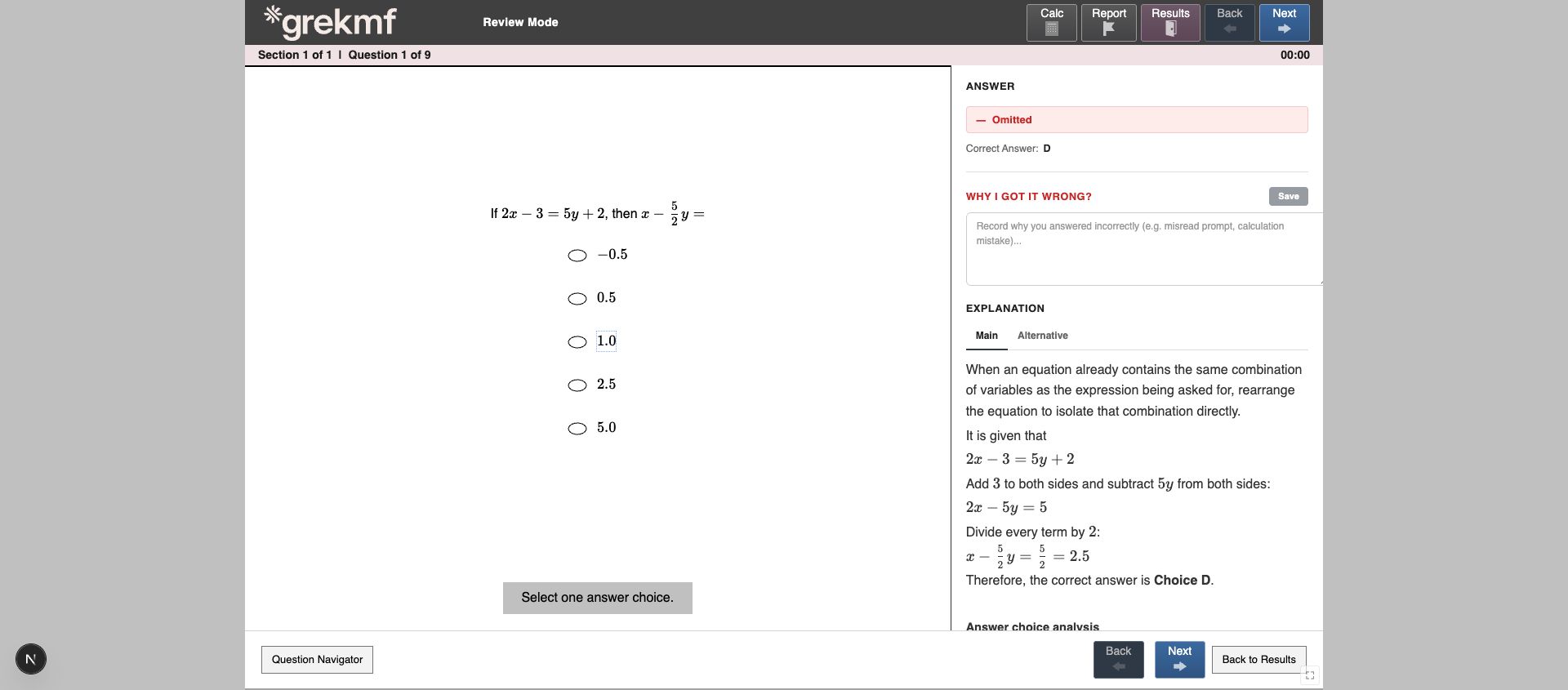
Question 1 · GREKMF #10
medium · mcq single
Show correct answer and full Premium explanation
Correct answer: D
An equation remains true when the same operation is applied to both sides. Isolating a linear combination of the variables often means rearranging and then dividing by a common coefficient.
It is given that $2x - 3 = 5y + 2$, and the goal is to find the value of $x - \frac{5}{2} y$.
Isolate the target expression
Step 1: Move the constant terms to produce a relation between $2x$ and $5y$. Add $3$ to both sides:
$2x = 5y + 5$.
Step 2: Subtract $5y$ from both sides:
$2x - 5y = 5$.
Step 3: Divide both sides by $2$:
$x - \frac{5}{2} y = \frac{5}{2} = 2.5$.
Check against the choices
Choice D: $2.5$ matches the value of $x - \frac{5}{2} y$.
Choice A: $-0.5$ could come from dividing $5$ by $-10$, or from an arithmetic sign error when moving constants.
Choice B: $0.5$ is $\frac{1}{2}$, which might result from dividing by $10$ instead of by $2$, or confusing $\frac{5}{2}$ with its reciprocal.
Choice C: $1.0$ might come from incorrectly concluding that $2x - 5y = 2$ and then dividing by $2$.
Choice E: $5.0$ is the value of $2x - 5y$ before dividing by $2$; stopping one step early produces this trap.
Things to Remember:
- To evaluate a linear combination, rearrange the given equation until that combination appears, then scale.
- Dividing an equation by $2$ halves every term, including the constant on the right.
- Stopping before the final division often produces a distractor equal to twice the correct answer.
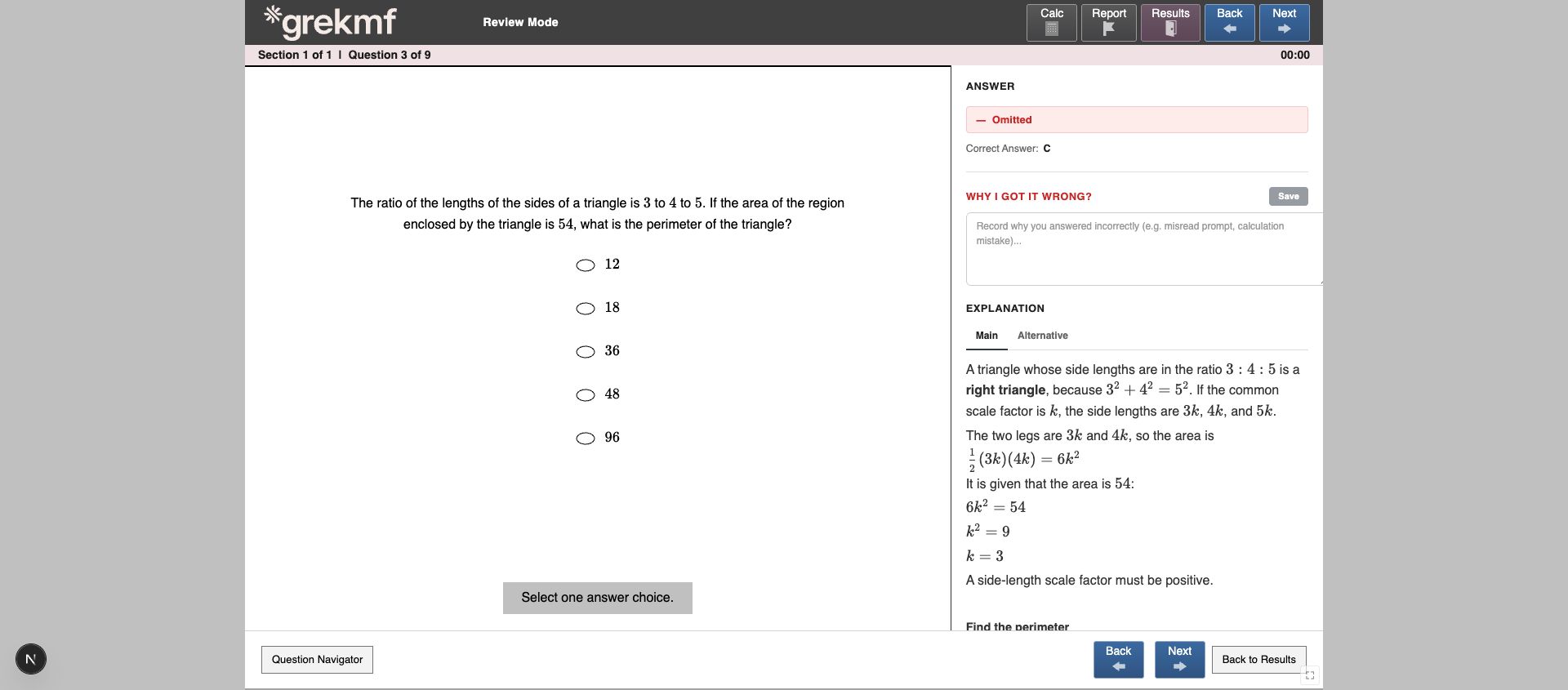
Question 2 · GREKMF #15
medium · mcq single
Show correct answer and full Premium explanation
Correct answer: C
A triangle with side lengths in the ratio $3:4:5$ is a right triangle: $3^2 + 4^2 = 9 + 16 = 25 = 5^2$, so the sides $3$ and $4$ are the legs and $5$ is the hypotenuse. The area of a right triangle is $\frac{1}{2} \times \text{leg}_1 \times \text{leg}_2$. The perimeter is the sum of all three side lengths.
It is given that the side ratio is $3$ to $4$ to $5$ and the enclosed area is $54$. Let the sides be $3k$, $4k$, and $5k$ for some positive scale factor $k$.
Find the scale factor from the area
$\text{Area} = \dfrac{1}{2}(3k)(4k) = 6k^2 = 54$
$k^2 = 9$
$k = 3$ (since length is positive)
Compute the perimeter
$\text{Perimeter} = 3k + 4k + 5k = 12k = 12 \cdot 3 = 36$
Check the choices
Choice C: $36$ is the correct perimeter.
Choice A: $12$ is the sum of the ratio parts $3+4+5$, forgetting to multiply by $k$.
Choice B: $18$ is $6k$ with $k = 3$, which is only the sum of the two legs, not the full perimeter.
Choice D: $48$ might come from treating $4k$ and $5k$ incorrectly as the legs, or from $16k$ with a wrong $k$.
Choice E: $96$ is $12k$ with $k = 8$, which could result from solving $6k = 54$ instead of $6k^2 = 54$.
Things to Remember:
- A $3$-$4$-$5$ triangle is right-angled, so area is half the product of the two shorter sides.
- Scale all three ratio parts by the same positive factor $k$ before computing perimeter.
- Area scales with $k^2$, while perimeter scales with $k$.
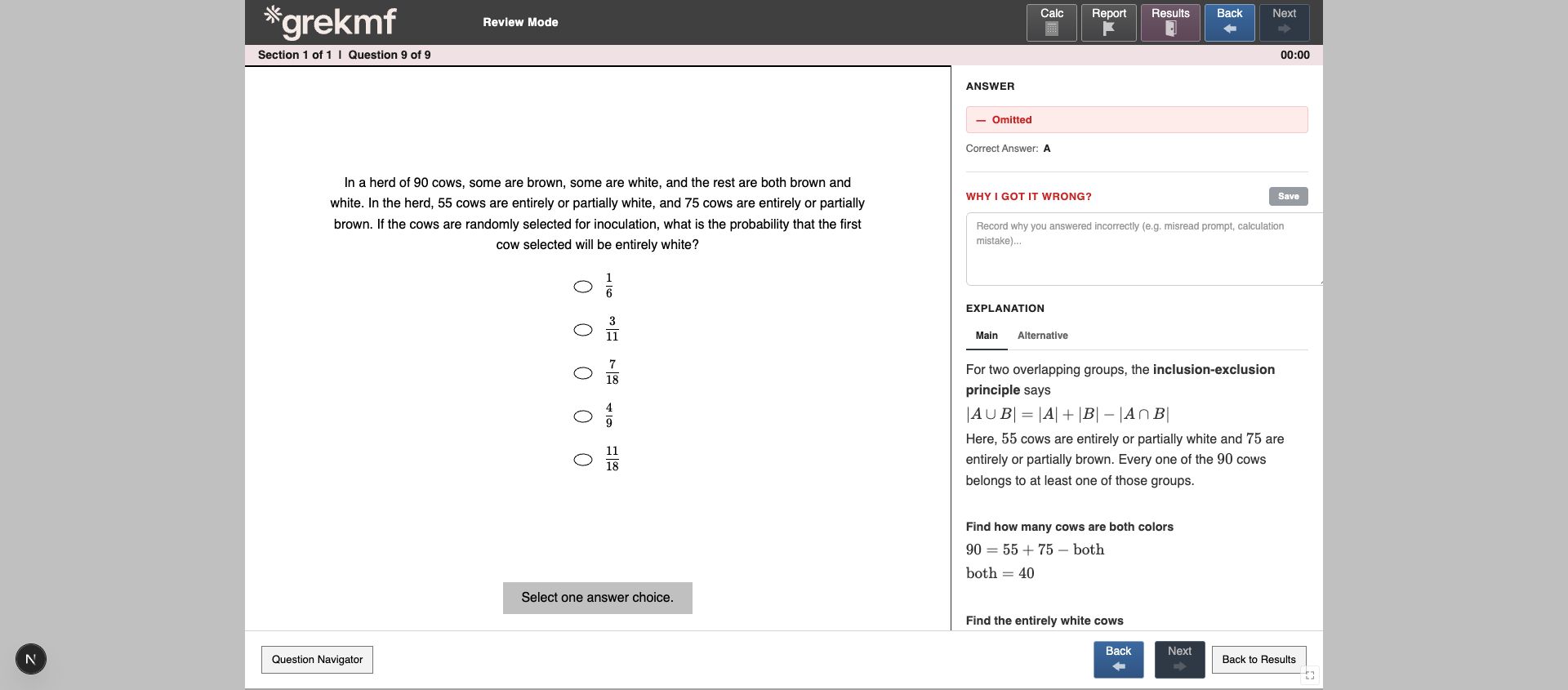
Question 3 · GREKMF #16
medium · mcq single
Show correct answer and full Premium explanation
Correct answer: A
For two overlapping sets, the inclusion–exclusion principle says $\lvert B \cup W \rvert = \lvert B \rvert + \lvert W \rvert - \lvert B \cap W \rvert$. The probability of an event, when outcomes are equally likely, is $\dfrac{\text{favorable outcomes}}{\text{total outcomes}}$.
It is given that a herd has $90$ cows; every cow is brown, white, or both. Also, $55$ cows are entirely or partially white, and $75$ are entirely or partially brown. Let $B$ be the set of cows that are entirely or partially brown and $W$ the set that are entirely or partially white. Then $\lvert B \rvert = 75$, $\lvert W \rvert = 55$, and $\lvert B \cup W \rvert = 90$.
Find the both-colored cows
$\lvert B \cap W \rvert = 75 + 55 - 90 = 40$.
Find entirely white cows
Entirely white means in $W$ but not in $B$:
$\lvert W \rvert - \lvert B \cap W \rvert = 55 - 40 = 15$.
Probability
$P(\text{first cow entirely white}) = \dfrac{15}{90} = \dfrac{1}{6}$.
Check the choices
Choice A: $\dfrac{1}{6}$ is correct.
Choice B: $\dfrac{3}{11}$ might come from using $55$ in the denominator or a related fraction with $33$ and $121$.
Choice C: $\dfrac{7}{18} = \dfrac{35}{90}$ could result from using $35$ entirely white cows (for example, $75 + 55 - 95$ or another off-by-count error).
Choice D: $\dfrac{4}{9} = \dfrac{40}{90}$ is the probability of selecting a both-colored cow, not an entirely white one.
Choice E: $\dfrac{11}{18} = \dfrac{55}{90}$ is the probability of selecting a cow that is entirely or partially white.
Things to Remember:
- $\lvert A \cup B \rvert = \lvert A \rvert + \lvert B \rvert - \lvert A \cap B \rvert$.
- “Entirely” one category excludes the intersection with the other category.
- Probability with random selection from a finite herd is favorable count over herd size.
Put the method into practice
Open the complete free KMF 1000
All 1,000 questions, 37 pairs, explanations, and skill tags are available on the non-expiring Free workspace with no card.
Start KMF 1000 freeSources and methodology
Check the primary sources
Frequently asked questions
Yes. GREKMF includes the complete KMF 1000 Quant series on the Free workspace with no card required.
Not initially if the method is unstable. Move toward 21 minutes for Base and 26 minutes for Hard as accuracy improves.
The attached schedules use one or two pairs depending on the timeline. Review capacity—not the desire to finish faster—should set the limit.