GRE Quant Practice Questions
GRE Quant improves fastest when each question becomes feedback. Learn the four tested content areas, solve a few representative questions, then use GREKMF's tags to drill the exact skill behind each miss.
What GRE Quant tests
GRE Quantitative Reasoning measures arithmetic, algebra, geometry, and data analysis. The mathematics is mostly high-school level; the difficulty comes from translating the prompt, choosing an efficient route, and avoiding answers built around predictable errors.
- Quantitative Comparison
- Single-answer and multiple-answer problem solving
- Numeric Entry
- Data Interpretation sets
A reliable Quant strategy
Name the tested concept before calculating. Estimate the likely range, write only the relationships you need, and check whether plugging in numbers or testing choices is faster than formal algebra.
- Read constraints before the question
- Track units and signs
- Use the calculator only when it saves time
- Review why each wrong choice was tempting
Common Quant traps
The GRE rewards careful setup more than heroic computation. Watch for percent change versus percentage points, diagrams that are not drawn to scale, hidden restrictions such as integer or positive, and questions that ask for a value different from the one you solved.
From the GREKMF question bank
Real questions with Premium explanations
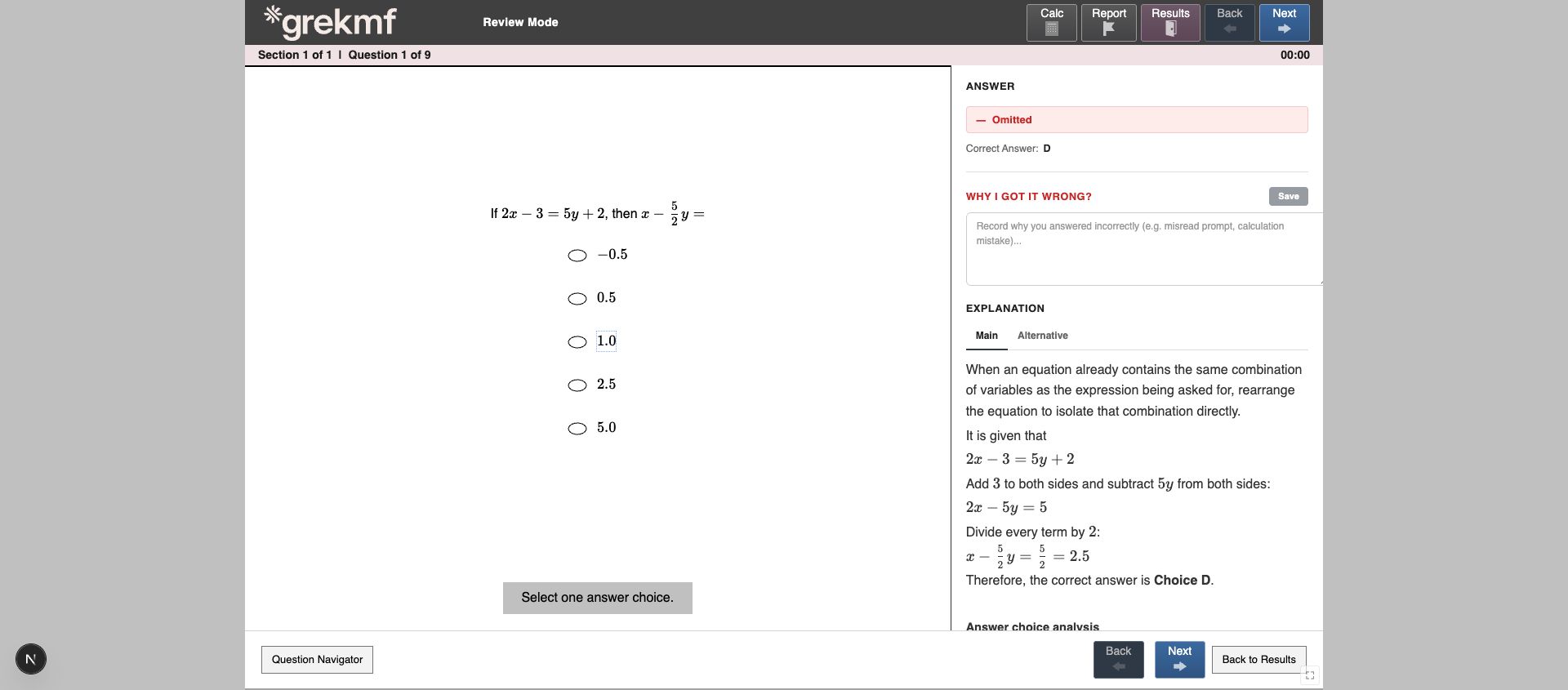
Question 1 · GREKMF #10
medium · mcq single
Show correct answer and full Premium explanation
Correct answer: D
An equation remains true when the same operation is applied to both sides. Isolating a linear combination of the variables often means rearranging and then dividing by a common coefficient.
It is given that $2x - 3 = 5y + 2$, and the goal is to find the value of $x - \frac{5}{2} y$.
Isolate the target expression
Step 1: Move the constant terms to produce a relation between $2x$ and $5y$. Add $3$ to both sides:
$2x = 5y + 5$.
Step 2: Subtract $5y$ from both sides:
$2x - 5y = 5$.
Step 3: Divide both sides by $2$:
$x - \frac{5}{2} y = \frac{5}{2} = 2.5$.
Check against the choices
Choice D: $2.5$ matches the value of $x - \frac{5}{2} y$.
Choice A: $-0.5$ could come from dividing $5$ by $-10$, or from an arithmetic sign error when moving constants.
Choice B: $0.5$ is $\frac{1}{2}$, which might result from dividing by $10$ instead of by $2$, or confusing $\frac{5}{2}$ with its reciprocal.
Choice C: $1.0$ might come from incorrectly concluding that $2x - 5y = 2$ and then dividing by $2$.
Choice E: $5.0$ is the value of $2x - 5y$ before dividing by $2$; stopping one step early produces this trap.
Things to Remember:
- To evaluate a linear combination, rearrange the given equation until that combination appears, then scale.
- Dividing an equation by $2$ halves every term, including the constant on the right.
- Stopping before the final division often produces a distractor equal to twice the correct answer.
Question 2 · GREKMF #15
medium · mcq single
Show correct answer and full Premium explanation
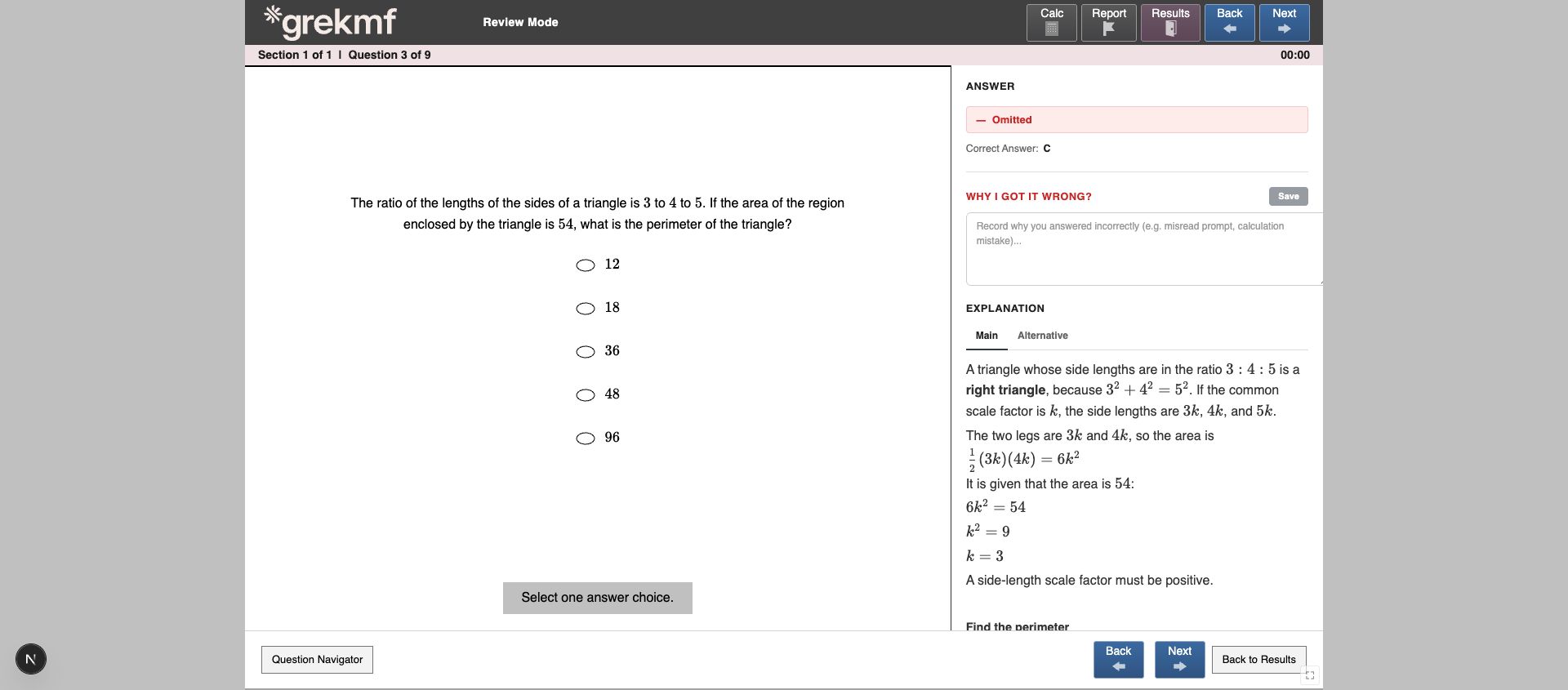
Correct answer: C
A triangle with side lengths in the ratio $3:4:5$ is a right triangle: $3^2 + 4^2 = 9 + 16 = 25 = 5^2$, so the sides $3$ and $4$ are the legs and $5$ is the hypotenuse. The area of a right triangle is $\frac{1}{2} \times \text{leg}_1 \times \text{leg}_2$. The perimeter is the sum of all three side lengths.
It is given that the side ratio is $3$ to $4$ to $5$ and the enclosed area is $54$. Let the sides be $3k$, $4k$, and $5k$ for some positive scale factor $k$.
Find the scale factor from the area
$\text{Area} = \dfrac{1}{2}(3k)(4k) = 6k^2 = 54$
$k^2 = 9$
$k = 3$ (since length is positive)
Compute the perimeter
$\text{Perimeter} = 3k + 4k + 5k = 12k = 12 \cdot 3 = 36$
Check the choices
Choice C: $36$ is the correct perimeter.
Choice A: $12$ is the sum of the ratio parts $3+4+5$, forgetting to multiply by $k$.
Choice B: $18$ is $6k$ with $k = 3$, which is only the sum of the two legs, not the full perimeter.
Choice D: $48$ might come from treating $4k$ and $5k$ incorrectly as the legs, or from $16k$ with a wrong $k$.
Choice E: $96$ is $12k$ with $k = 8$, which could result from solving $6k = 54$ instead of $6k^2 = 54$.
Things to Remember:
- A $3$-$4$-$5$ triangle is right-angled, so area is half the product of the two shorter sides.
- Scale all three ratio parts by the same positive factor $k$ before computing perimeter.
- Area scales with $k^2$, while perimeter scales with $k$.
Question 3 · GREKMF #16
medium · mcq single
Show correct answer and full Premium explanation
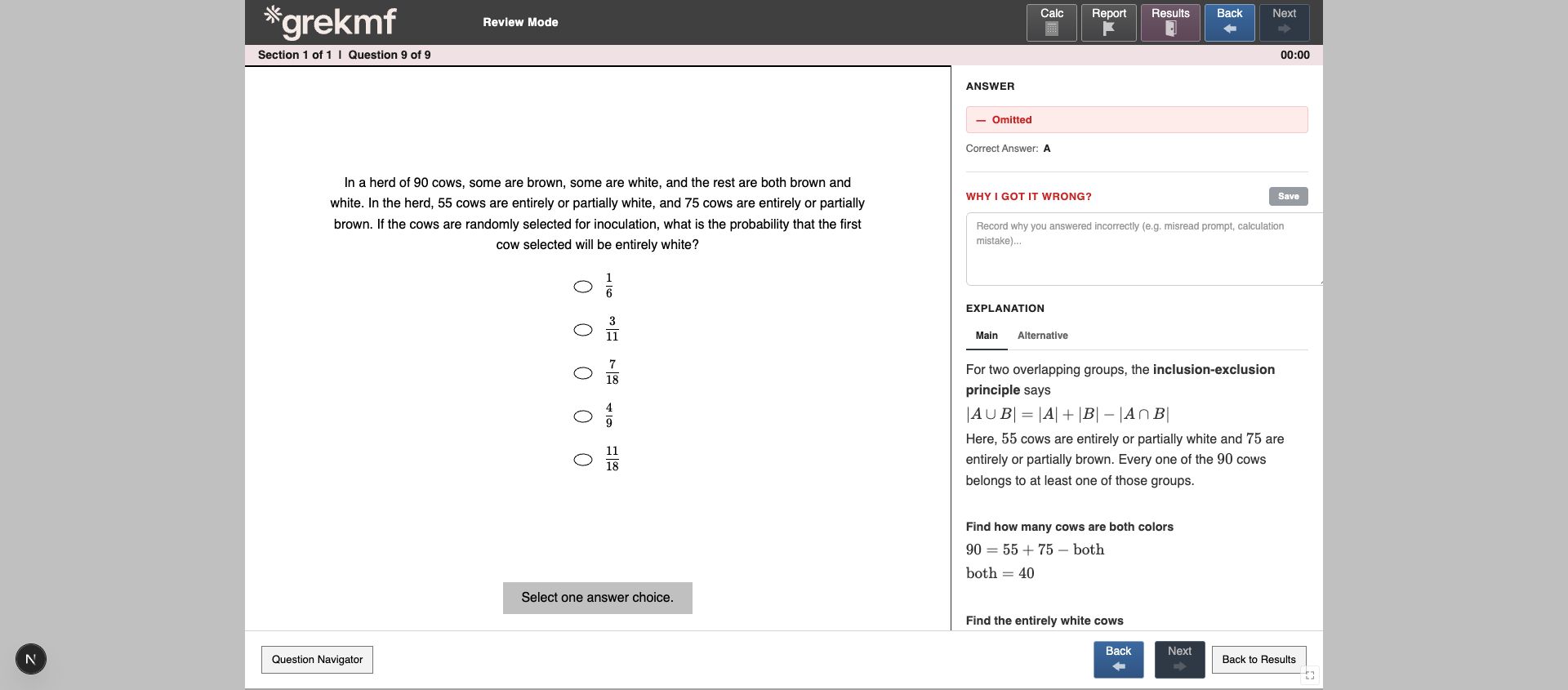
Correct answer: A
For two overlapping sets, the inclusion–exclusion principle says $\lvert B \cup W \rvert = \lvert B \rvert + \lvert W \rvert - \lvert B \cap W \rvert$. The probability of an event, when outcomes are equally likely, is $\dfrac{\text{favorable outcomes}}{\text{total outcomes}}$.
It is given that a herd has $90$ cows; every cow is brown, white, or both. Also, $55$ cows are entirely or partially white, and $75$ are entirely or partially brown. Let $B$ be the set of cows that are entirely or partially brown and $W$ the set that are entirely or partially white. Then $\lvert B \rvert = 75$, $\lvert W \rvert = 55$, and $\lvert B \cup W \rvert = 90$.
Find the both-colored cows
$\lvert B \cap W \rvert = 75 + 55 - 90 = 40$.
Find entirely white cows
Entirely white means in $W$ but not in $B$:
$\lvert W \rvert - \lvert B \cap W \rvert = 55 - 40 = 15$.
Probability
$P(\text{first cow entirely white}) = \dfrac{15}{90} = \dfrac{1}{6}$.
Check the choices
Choice A: $\dfrac{1}{6}$ is correct.
Choice B: $\dfrac{3}{11}$ might come from using $55$ in the denominator or a related fraction with $33$ and $121$.
Choice C: $\dfrac{7}{18} = \dfrac{35}{90}$ could result from using $35$ entirely white cows (for example, $75 + 55 - 95$ or another off-by-count error).
Choice D: $\dfrac{4}{9} = \dfrac{40}{90}$ is the probability of selecting a both-colored cow, not an entirely white one.
Choice E: $\dfrac{11}{18} = \dfrac{55}{90}$ is the probability of selecting a cow that is entirely or partially white.
Things to Remember:
- $\lvert A \cup B \rvert = \lvert A \rvert + \lvert B \rvert - \lvert A \cap B \rvert$.
- “Entirely” one category excludes the intersection with the other category.
- Probability with random selection from a finite herd is favorable count over herd size.
Put the method into practice
Practice in GREKMF’s exam-like question bank
Move from the guide to a focused set, then review detailed explanations and skill-level performance. The KMF 1000 Quant series is free and requires no card.
Start free GRE practiceFrequently asked questions
Start with 10–20 carefully reviewed questions. Increase volume only when you can explain every miss and identify the tested skill.
Yes. GREKMF includes the complete 1,000-question KMF Quant series on the Free plan with no card required.
Learn new skills untimed, then use timed sets to make the method automatic. Alternate both modes.