GRE Quant Study Plan
A Quant plan should not be a tour through a textbook. Learn the minimum concept needed, apply it to serious questions, classify the mistake, and revisit the skill in mixed conditions until the method survives the clock.
1,000
Free Quant questions
Organized into 37 Base + Hard pairs.
47 min
Timed pair
12 Base questions plus 15 Hard questions.
4
Content domains
Arithmetic, algebra, geometry, and data analysis.
The working method
A sequence you can repeat
Diagnose by unit, not by total score
Separate arithmetic, algebra, geometry, and data analysis, then inspect subskills and question formats.
Learn just enough to unlock practice
Refresh definitions and high-frequency methods, then solve before the lesson becomes passive consumption.
Build a clean untimed process
Name the concept, write constraints, estimate, choose a route, and check the requested quantity.
Mix topics and add official timing
Remove the topic label, use Base/Hard pairs, and practice skipping, returning, and calculator decisions.
Phase 1: rebuild high-leverage foundations
Start with number properties, fractions and ratios, percentages, exponents and roots, equations and inequalities, coordinate relationships, core geometry, and descriptive statistics. Do not wait to finish every chapter before solving questions.
For each skill, aim to explain why the method works and when a shortcut is safe. Memorized tricks without constraints are a common source of Quantitative Comparison errors.
Phase 2: use KMF 1000 as structured training
Each of the 37 pairs contains a 12-question Base set and 15-question Hard set. Early pairs can be untimed while you stabilize setup. Later, use the intended 21- and 26-minute clocks, review both misses and slow correct answers, and preserve unseen pairs for checkpoints.
- Retry before reading
- Tag the tested unit
- Label the failure mode
- Write a prevention rule
- Re-solve after memory fades
Phase 3: remove the topic label
Topic practice teaches execution; mixed practice teaches recognition. Once isolated accuracy is stable, mix neighboring concepts, then all four domains. Include QC, single-answer, multiple-answer, numeric-entry, and data interpretation formats.
Phase 4: make timing a decision system
Timing is not solving every question at the same speed. Rehearse a first-pass threshold, mark expensive questions, bank accessible points, and return with remaining time. Estimate before calculator use and audit whether the calculator reduced work or merely added keystrokes.
A repeatable Quant week
Use two days for focused foundation and unit drills, two days for KMF Base/Hard pairs, one day for mixed transfer, and one day for delayed re-solving and analytics. The seventh day can be a lighter recovery block or a timed checkpoint, depending on the timeline.
At the weekly review, ask four questions: Which unit lost the most points? Which correct answers were too slow? Which error label repeated? Which later unseen set will verify the repair? The answers should determine next week’s extra block.
- Focused unit repair
- Structured KMF pairs
- Mixed recognition practice
- Delayed error-log review
Avoid the false comfort of solution familiarity
A previously missed question can feel easy because you remember the explanation. That is useful for checking the method but weak evidence of mastery. After re-solving, test the same unit on an unseen item with different surface details.
Keep a distinction between reviewed accuracy and fresh accuracy. Your readiness decisions should be based primarily on unseen mixed work and preserved official tests, while reviewed work confirms that you understand the correction.
From the GREKMF question bank
Real questions with Premium explanations
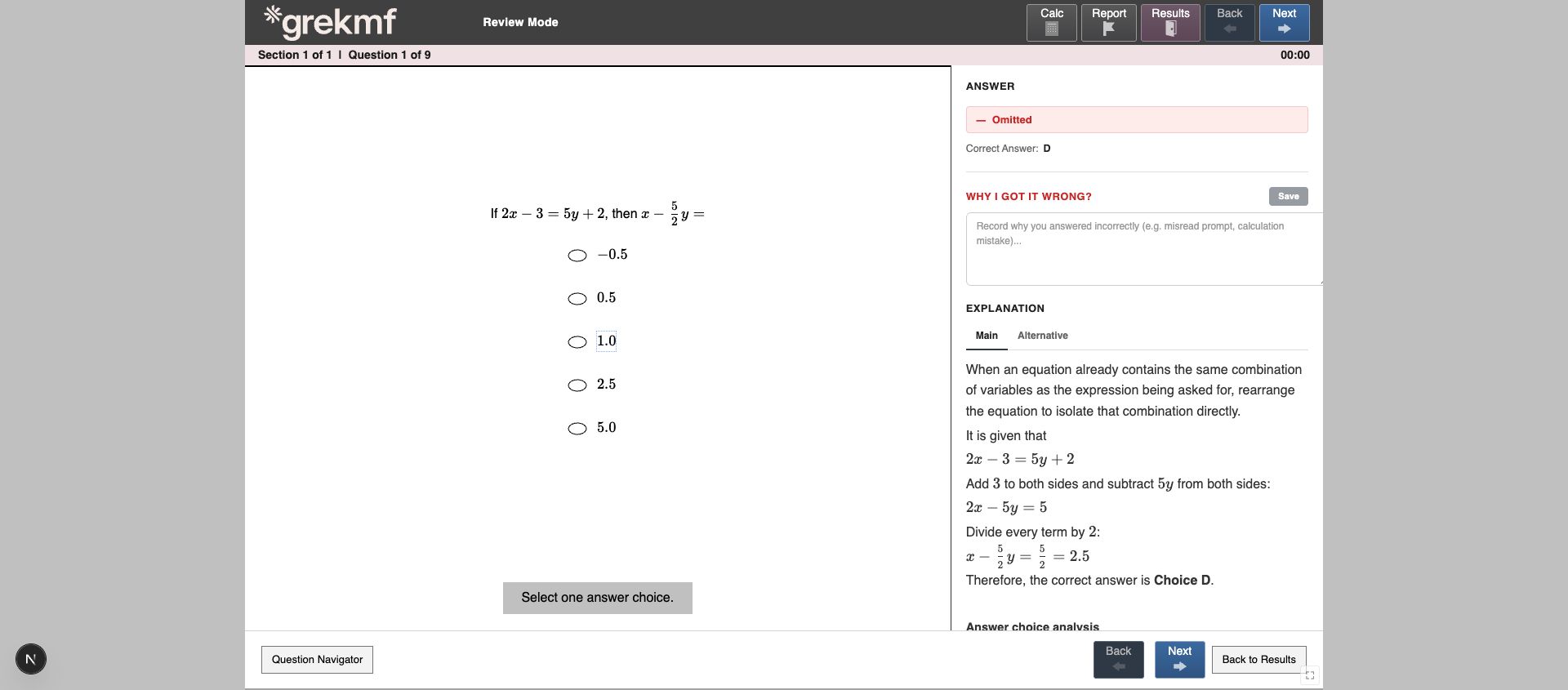
Question 1 · GREKMF #10
medium · mcq single
Show correct answer and full Premium explanation
Correct answer: D
An equation remains true when the same operation is applied to both sides. Isolating a linear combination of the variables often means rearranging and then dividing by a common coefficient.
It is given that $2x - 3 = 5y + 2$, and the goal is to find the value of $x - \frac{5}{2} y$.
Isolate the target expression
Step 1: Move the constant terms to produce a relation between $2x$ and $5y$. Add $3$ to both sides:
$2x = 5y + 5$.
Step 2: Subtract $5y$ from both sides:
$2x - 5y = 5$.
Step 3: Divide both sides by $2$:
$x - \frac{5}{2} y = \frac{5}{2} = 2.5$.
Check against the choices
Choice D: $2.5$ matches the value of $x - \frac{5}{2} y$.
Choice A: $-0.5$ could come from dividing $5$ by $-10$, or from an arithmetic sign error when moving constants.
Choice B: $0.5$ is $\frac{1}{2}$, which might result from dividing by $10$ instead of by $2$, or confusing $\frac{5}{2}$ with its reciprocal.
Choice C: $1.0$ might come from incorrectly concluding that $2x - 5y = 2$ and then dividing by $2$.
Choice E: $5.0$ is the value of $2x - 5y$ before dividing by $2$; stopping one step early produces this trap.
Things to Remember:
- To evaluate a linear combination, rearrange the given equation until that combination appears, then scale.
- Dividing an equation by $2$ halves every term, including the constant on the right.
- Stopping before the final division often produces a distractor equal to twice the correct answer.
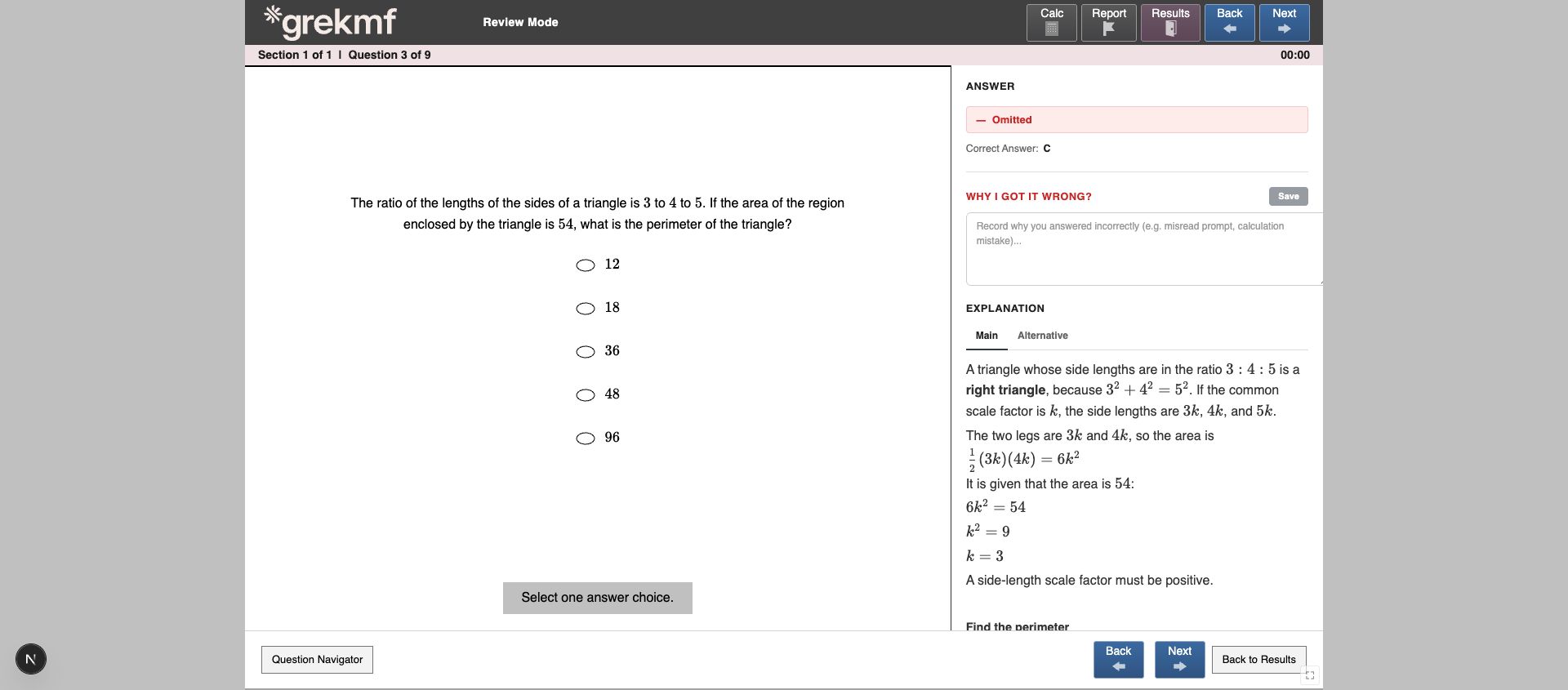
Question 2 · GREKMF #15
medium · mcq single
Show correct answer and full Premium explanation
Correct answer: C
A triangle with side lengths in the ratio $3:4:5$ is a right triangle: $3^2 + 4^2 = 9 + 16 = 25 = 5^2$, so the sides $3$ and $4$ are the legs and $5$ is the hypotenuse. The area of a right triangle is $\frac{1}{2} \times \text{leg}_1 \times \text{leg}_2$. The perimeter is the sum of all three side lengths.
It is given that the side ratio is $3$ to $4$ to $5$ and the enclosed area is $54$. Let the sides be $3k$, $4k$, and $5k$ for some positive scale factor $k$.
Find the scale factor from the area
$\text{Area} = \dfrac{1}{2}(3k)(4k) = 6k^2 = 54$
$k^2 = 9$
$k = 3$ (since length is positive)
Compute the perimeter
$\text{Perimeter} = 3k + 4k + 5k = 12k = 12 \cdot 3 = 36$
Check the choices
Choice C: $36$ is the correct perimeter.
Choice A: $12$ is the sum of the ratio parts $3+4+5$, forgetting to multiply by $k$.
Choice B: $18$ is $6k$ with $k = 3$, which is only the sum of the two legs, not the full perimeter.
Choice D: $48$ might come from treating $4k$ and $5k$ incorrectly as the legs, or from $16k$ with a wrong $k$.
Choice E: $96$ is $12k$ with $k = 8$, which could result from solving $6k = 54$ instead of $6k^2 = 54$.
Things to Remember:
- A $3$-$4$-$5$ triangle is right-angled, so area is half the product of the two shorter sides.
- Scale all three ratio parts by the same positive factor $k$ before computing perimeter.
- Area scales with $k^2$, while perimeter scales with $k$.
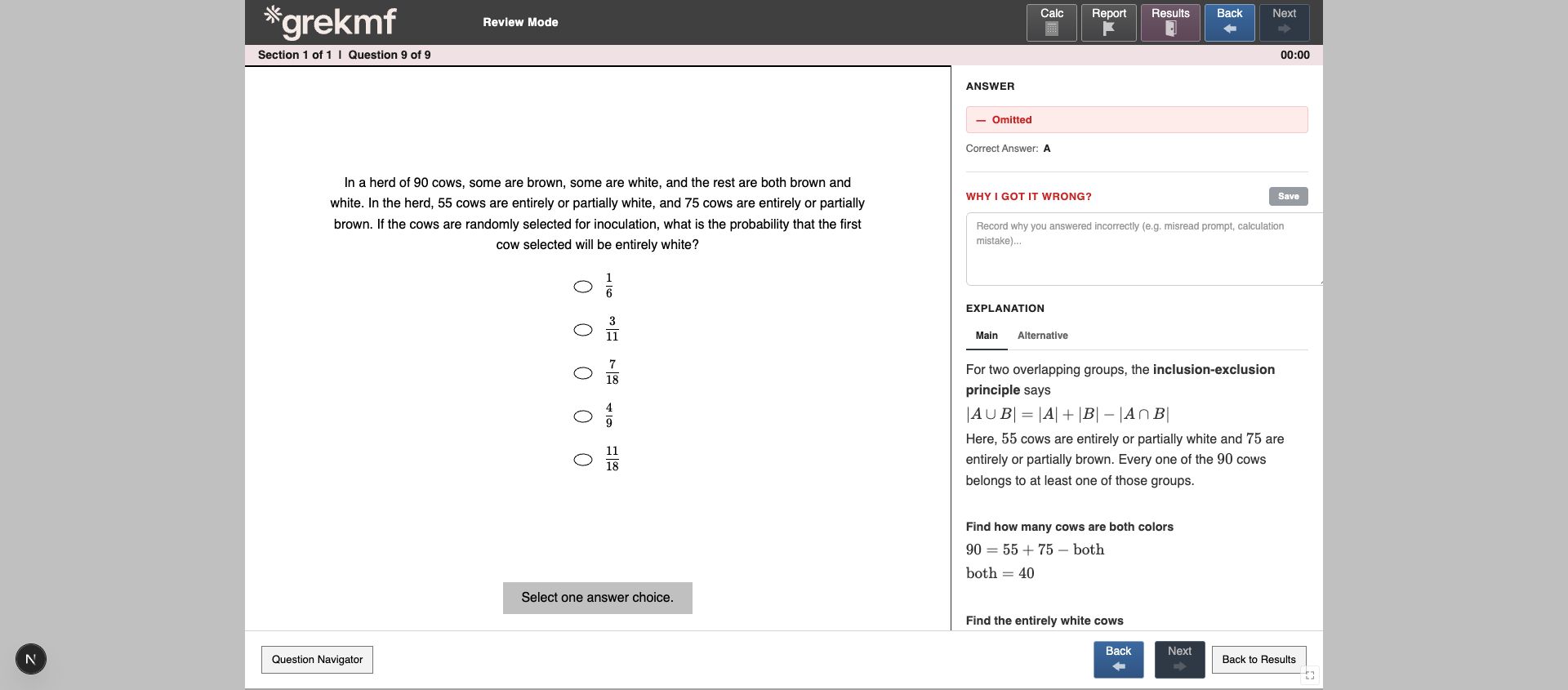
Question 3 · GREKMF #16
medium · mcq single
Show correct answer and full Premium explanation
Correct answer: A
For two overlapping sets, the inclusion–exclusion principle says $\lvert B \cup W \rvert = \lvert B \rvert + \lvert W \rvert - \lvert B \cap W \rvert$. The probability of an event, when outcomes are equally likely, is $\dfrac{\text{favorable outcomes}}{\text{total outcomes}}$.
It is given that a herd has $90$ cows; every cow is brown, white, or both. Also, $55$ cows are entirely or partially white, and $75$ are entirely or partially brown. Let $B$ be the set of cows that are entirely or partially brown and $W$ the set that are entirely or partially white. Then $\lvert B \rvert = 75$, $\lvert W \rvert = 55$, and $\lvert B \cup W \rvert = 90$.
Find the both-colored cows
$\lvert B \cap W \rvert = 75 + 55 - 90 = 40$.
Find entirely white cows
Entirely white means in $W$ but not in $B$:
$\lvert W \rvert - \lvert B \cap W \rvert = 55 - 40 = 15$.
Probability
$P(\text{first cow entirely white}) = \dfrac{15}{90} = \dfrac{1}{6}$.
Check the choices
Choice A: $\dfrac{1}{6}$ is correct.
Choice B: $\dfrac{3}{11}$ might come from using $55$ in the denominator or a related fraction with $33$ and $121$.
Choice C: $\dfrac{7}{18} = \dfrac{35}{90}$ could result from using $35$ entirely white cows (for example, $75 + 55 - 95$ or another off-by-count error).
Choice D: $\dfrac{4}{9} = \dfrac{40}{90}$ is the probability of selecting a both-colored cow, not an entirely white one.
Choice E: $\dfrac{11}{18} = \dfrac{55}{90}$ is the probability of selecting a cow that is entirely or partially white.
Things to Remember:
- $\lvert A \cup B \rvert = \lvert A \rvert + \lvert B \rvert - \lvert A \cap B \rvert$.
- “Entirely” one category excludes the intersection with the other category.
- Probability with random selection from a finite herd is favorable count over herd size.
Put the method into practice
Practice in GREKMF’s exam-like question bank
Move from the guide to a focused set, then review detailed explanations and skill-level performance. The KMF 1000 Quant series is free and requires no card.
Start KMF 1000 freeSources and methodology
Check the primary sources
Frequently asked questions
Build arithmetic and algebra foundations first, while introducing geometry and data analysis early enough for repeated review. Move from isolated skills to mixed sets.
Time sets after the method is reliable. The intended pair timing is 21 minutes for 12 Base questions and 26 minutes for 15 Hard questions.
You can identify the method without a label, solve accurately on unseen questions, explain misses, and maintain the process under moderate time pressure.