GRE Quantitative Comparison Practice
Quantitative Comparison rewards comparison, not complete calculation. Your task is to decide the relationship between two quantities under every allowed case.
The four QC answers
The choices are always the same: Quantity A is greater, Quantity B is greater, the quantities are equal, or the relationship cannot be determined.
- A is always greater
- B is always greater
- The quantities are always equal
- Different valid cases produce different results
Test cases strategically
Simplify first. When variables remain, test boundary values, zero, one, negatives, fractions, and values on either side of a critical point—only when the prompt allows them.
- Never assume a diagram is to scale
- Respect integer and positivity constraints
- One counterexample can prove choice D
Common QC traps
Students often prove one case and stop, assume a variable is positive, over-compute both columns, or choose equality because two expressions look algebraically similar.
From the GREKMF question bank
Real questions with Premium explanations
Question 1 · GREKMF #1006
medium · comparison
Show correct answer and full Premium explanation
Correct answer: A
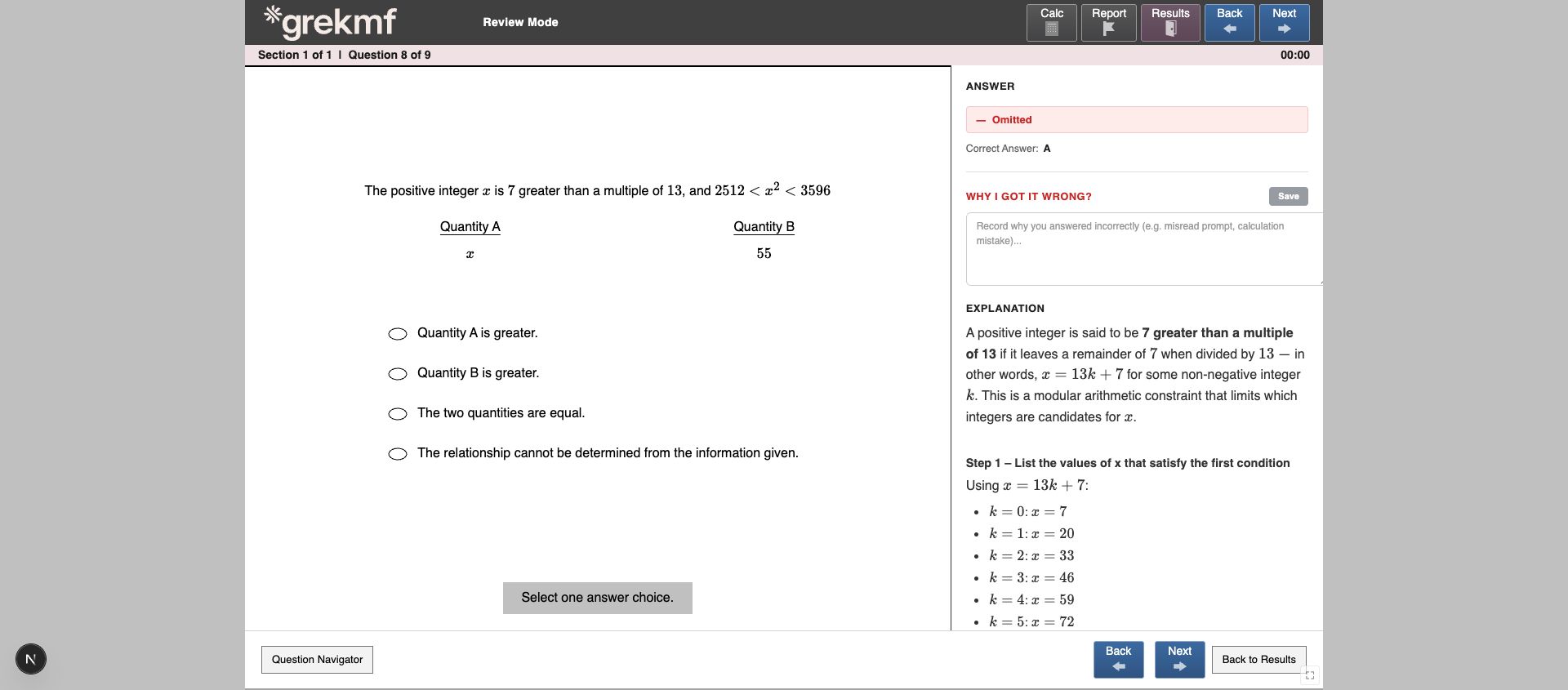
A positive integer is said to be 7 greater than a multiple of 13 if it leaves a remainder of $7$ when divided by $13$ — in other words, $x = 13k + 7$ for some non-negative integer $k$. This is a modular arithmetic constraint that limits which integers are candidates for $x$.
Step 1 – List the values of x that satisfy the first condition
Using $x = 13k + 7$:
- $k = 0$: $x = 7$
- $k = 1$: $x = 20$
- $k = 2$: $x = 33$
- $k = 3$: $x = 46$
- $k = 4$: $x = 59$
- $k = 5$: $x = 72$
Step 2 – Apply the second condition: 2512 < x² < 3596
To find the range of $x$, take square roots of all three parts. Since $x$ is a positive integer:
$\sqrt{2512} \approx 50.1 \quad$ and $\quad \sqrt{3596} \approx 59.97$
So $x$ must satisfy $51 \le x \le 59$.
Step 3 – Find x that satisfies both conditions
From the list in Step 1, the only value in the range $51 \le x \le 59$ is $x = 59$.
Verify: $59 = 13 \times 4 + 7$ ✓ and $59^2 = 3481$, and $2512 \lt 3481 \lt 3596$ ✓
Compare Quantity A and Quantity B
Quantity A $= x = 59$
Quantity B $= 55$
Since $59 \gt 55$, Quantity A is greater.
Why the other conclusions don't hold
Quantity A is greater: $x = 59$, which is greater than $55$. Correct.
Quantity B is greater: Would require $x \lt 55$. The only valid candidate, $59$, is greater than $55$. Incorrect.
The two quantities are equal: Would require $x = 55$. But $55 = 13 \times 4 + 3$ (remainder $3$, not $7$), so $55$ does not satisfy the first condition. Incorrect.
The relationship cannot be determined: Both conditions uniquely determine $x = 59$, so the comparison is definitive. Incorrect.
Things to Remember:
- "$r$ greater than a multiple of $n$" means $x = nk + r$, i.e., $x$ leaves remainder $r$ when divided by $n$.
- To bound $x$ from a constraint on $x^2$, take square roots of both sides and restrict to positive integers.
- When both conditions uniquely determine the unknown, the QC answer is always A, B, or C — never D.
Question 2 · GREKMF #1007
medium · comparison
Show correct answer and full Premium explanation
Correct answer: A
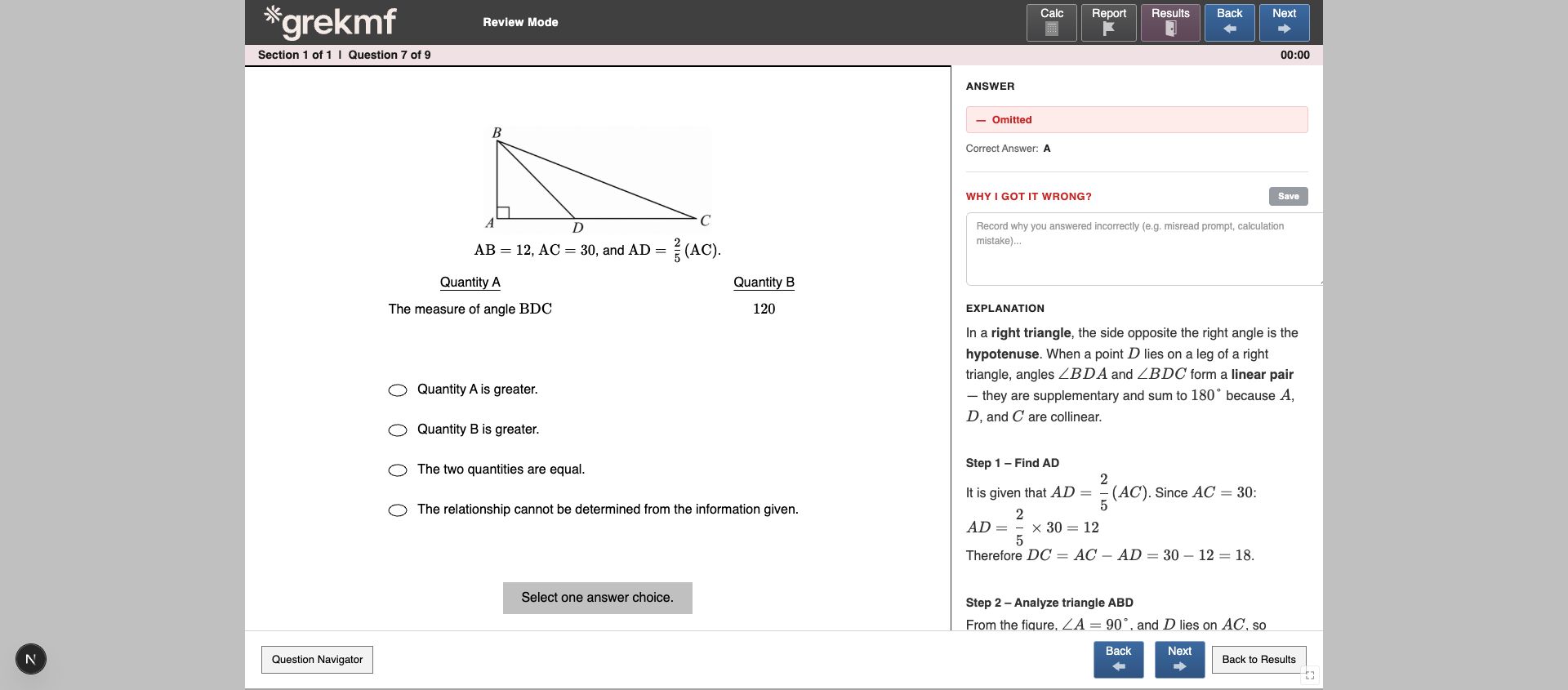
In a right triangle, the side opposite the right angle is the hypotenuse. When a point $D$ lies on a leg of a right triangle, angles $\angle BDA$ and $\angle BDC$ form a linear pair — they are supplementary and sum to $180\degree$ because $A$, $D$, and $C$ are collinear.
Step 1 – Find AD
It is given that $AD = \dfrac{2}{5}(AC)$. Since $AC = 30$:
$AD = \dfrac{2}{5} \times 30 = 12$
Therefore $DC = AC - AD = 30 - 12 = 18$.
Step 2 – Analyze triangle ABD
From the figure, $\angle A = 90\degree$, and $D$ lies on $AC$, so $\angle DAB = 90\degree$ as well. In right triangle $ABD$, it is given that $AB = 12$ and $AD = 12$. Since both legs are equal, triangle $ABD$ is an isosceles right triangle, and the two base angles are each $45\degree$:
$\angle ADB = 45\degree$
Step 3 – Find angle BDC
Since $A$, $D$, $C$ are collinear, $\angle ADB$ and $\angle BDC$ are supplementary:
$\angle BDC = 180\degree - \angle ADB = 180\degree - 45\degree = 135\degree$
Compare Quantity A and Quantity B
Quantity A $= 135\degree$, Quantity B $= 120\degree$. Since $135 \gt 120$, Quantity A is greater.
Why the other conclusions don't hold
Quantity A is greater: $\angle BDC = 135\degree \gt 120\degree$. Correct.
Quantity B is greater: Would require $\angle BDC \lt 120\degree$. The only candidate is $135\degree$. Incorrect.
The two quantities are equal: Would require $\angle BDC = 120\degree \neq 135\degree$. Incorrect.
The relationship cannot be determined: All values are uniquely determined. Incorrect.
Things to Remember:
- When $D$ lies between $A$ and $C$ on a line, $\angle BDA + \angle BDC = 180\degree$ (linear pair / supplementary angles).
- An isosceles right triangle (equal legs, right angle between them) has base angles of $45\degree$ each.
- To find an angle using supplementary pairs, subtract the known angle from $180\degree$.
Question 3 · GREKMF #1010
medium · comparison
Show correct answer and full Premium explanation
Correct answer: D
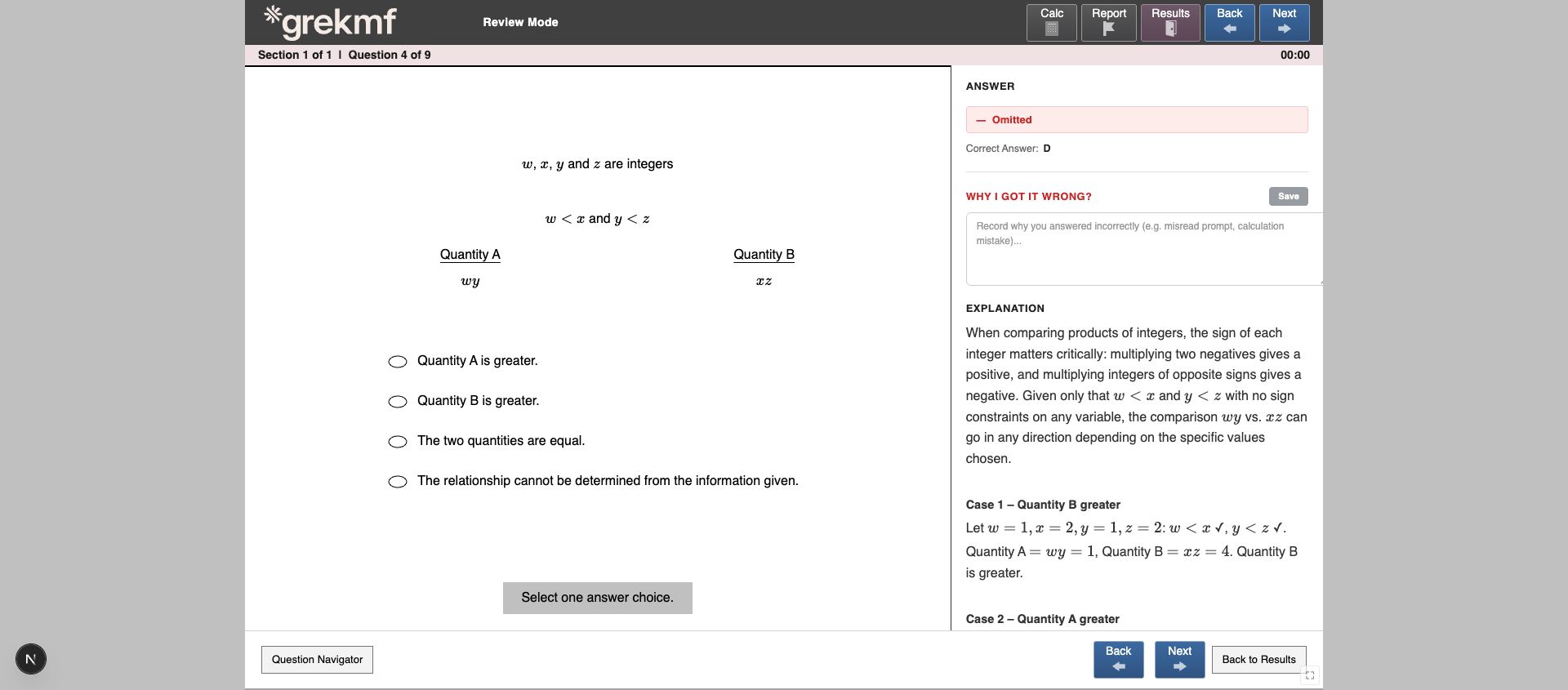
When comparing products of integers, the sign of each integer matters critically: multiplying two negatives gives a positive, and multiplying integers of opposite signs gives a negative. Given only that $w \lt x$ and $y \lt z$ with no sign constraints on any variable, the comparison $wy$ vs. $xz$ can go in any direction depending on the specific values chosen.
Case 1 – Quantity B greater
Let $w = 1, x = 2, y = 1, z = 2$: $w \lt x$ ✓, $y \lt z$ ✓.
Quantity A $= wy = 1$, Quantity B $= xz = 4$. Quantity B is greater.
Case 2 – Quantity A greater
Let $w = -4, x = -1, y = -2, z = -1$: $-4 \lt -1$ ✓, $-2 \lt -1$ ✓.
Quantity A $= wy = (-4)(-2) = 8$, Quantity B $= xz = (-1)(-1) = 1$. Quantity A is greater.
Conclusion
Since valid choices produce different comparison outcomes, the relationship cannot be determined from the given information alone.
Why the other conclusions don’t hold
Quantity A is greater: True in Case 2, false in Case 1. Incorrect.
Quantity B is greater: True in Case 1, false in Case 2. Incorrect.
The two quantities are equal: Not consistently true. Incorrect.
The relationship cannot be determined: Multiple comparison outcomes are achievable. Correct.
Things to Remember:
- An inequality $a \lt b$ does not imply $ac \lt bc$; if $c \lt 0$, multiplying reverses the inequality.
- When signs are unconstrained, test positive-positive and negative-negative cases to probe which quantity is larger.
- Proving “cannot be determined” requires at least two valid cases with different comparison outcomes.
Put the method into practice
Practice in GREKMF’s exam-like question bank
Move from the guide to a focused set, then review detailed explanations and skill-level performance. The KMF 1000 Quant series is free and requires no card.
Start free GRE practiceFrequently asked questions
Choose it when two or more valid cases produce different relationships.
Yes. Strategic number testing is one of the best QC methods when variables and ranges permit it.
Yes, with the same four relationship choices on every item.